The World Is Changing Faster Than Most Believe
Table of Contents
Where will we be in the coming years?
We humans are wired to see the future as a straight line, a gentle continuation of today. But that linearity is a comfortable illusion. In reality, we are moving in an accelerating spiral.
For a long time, I believed that being a programmer was the ultimate anchor in this storm, a place where logic and craftsmanship form an untouchable symbiosis. But today I have to admit to myself: even the architects of the digital world are not safe from their own creation. What we declared “future-proof” for decades turns out to be a snapshot. The dramatic speed at which technical knowledge is being devalued today is not just a market trend; it is a fundamental shift in our understanding of work and mastery.
We don’t underestimate the future because we lack imagination, but because we try to measure tomorrow’s world with yesterday’s inertia. And that blind spot is our greatest risk.
I’ve been in enough tech companies in my life to see this dynamic play out multiple times. There are phases when a company feels electrified: too much work, too many opportunities, too few people to execute it all. In those phases, politics, territorial thinking, and turf wars often disappear on their own. Then there are the other phases: fewer real opportunities, more people than leverage, more status games, more processes, more theater.
Many companies still believe they have time. They don’t.
The Thinking Error: We Compare AI to Old Adoption Curves
When people talk about AI, many speak as if we still have all the time in the world. As if this were a slow cultural shift. As if it would somehow settle over decades.
But look at how dramatically the pace has accelerated: while the car (Ford Model T) took about 22 years to become mainstream in the US, the smartphone made the leap in just 14 years. With software, friction has almost entirely disappeared: ChatGPT reached 100 million users in two months, Threads in just five days.
Technology doesn’t just spread today, it explodes into target groups in ways that used to take decades. The reason is simple: AI doesn’t need factories or supply chains at the end user’s side. A link or an API is enough to instantly upgrade existing hardware with new capabilities.
What’s Different Today
In the past, you had to produce something, ship it, sell it, and physically bring it into households.
Today, a link is often enough.
A new AI tool can appear on a Friday evening, get pushed through X, Reddit, Discord, and YouTube over the weekend, and by Monday, tens of thousands of people are already testing it in real workflows. Not in demos. Not in research. In real work.
That’s exactly why I find developments like OpenClaw or the whole wave around agentic coding setups so interesting. Not just because of the tool itself, but because of the pace. Suddenly people burn through token budgets overnight, entire workflows get restructured, and within a few weeks, what counts as “normal” in a dev team shifts.
A good example is Claude Cowork: the project was launched publicly just ten days after the idea was born. Ten days. That alone shows what we’re talking about.
Many people still think in product cycles of quarters. AI already thinks in days.
The Future Is Often Built In Years Before
The future often appears sudden, even though it was built into devices long ago. Apple’s U1 chip was already in the iPhone 11 in 2019, but the tangible benefit only came in 2021 with AirTag. The new Studio Display already contains an A19 according to firmware analyses, without Apple making a big deal of it. Tesla has been selling vehicles for years that receive new capabilities via over-the-air updates, even though Full Self-Driving officially still requires driver supervision.
The pattern is always the same: the hardware is already out there. When the software is ready, new capabilities don’t spread over years but over weeks. Not only do products spread faster, capabilities within already-sold products can suddenly multiply.
The Next Big Push Won’t Just Hit Software
A common mistake in the discussion is seeing AI as a topic only for developers, designers, or knowledge workers.
That’s too narrow.
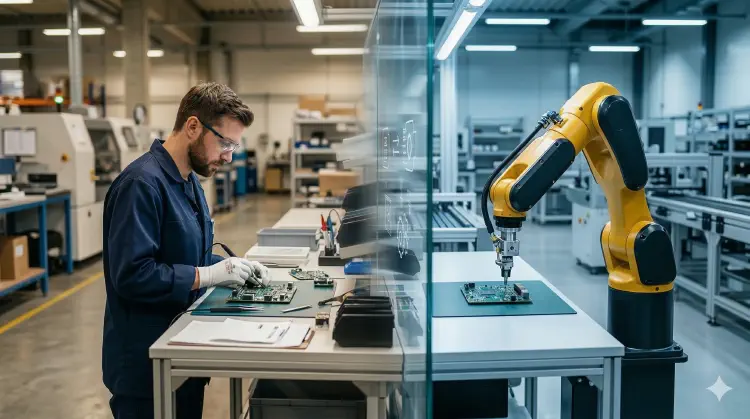
The real impact comes when AI merges with automation and robotics. Take McDonald’s: we’re not waiting for a humanoid kitchen robot, we’ve already accepted automation. The self-order terminal was the decisive step.
It dehumanized the ordering process, increased revenue, and got us used to software-mediated workflows. When more robotics enter the kitchen, they’ll arrive in a system the customer has already accepted as “digitally controlled.” The rollout won’t be a question of whether, only of pace, not out of malice but out of logic: a system that is cheaper, more predictable, and more reliable in the long run will almost inevitably be adopted when competitive pressure is high enough.
Often It’s Simply Economic Logic
Many of these developments don’t happen because they’re nicer or more culturally desirable for everyone. They happen because they simply become logical in a given market environment.
You can see this with cars: on March 10, 2026, it was announced that Volkswagen plans to cut around 50,000 jobs in Germany by 2030. Not due to incompetence, but because the old structure is fighting against the new logic (focus on software, vertical integration). While established corporations wrestle with historical complexity, companies like Tesla or BYD scale their manufacturing at a pace that no longer fits old benchmarks. When a market tips, speed matters more than size.
This also applies on a smaller scale, such as the disappearance of traditional craftsmanship across Europe. Everywhere we see small businesses that stood for quality over generations losing to industrial chains. This isn’t just a cultural loss but naked market logic: when rising costs and declining purchasing power turn quality into a luxury, the industrial alternative wins, not because it’s better, but because the old model simply no longer works economically.
It Won’t Explode Everywhere at Once, but It Will Creep In Almost Everywhere
I don’t believe in the simple Hollywood scenario where all jobs are gone tomorrow and everything is done by robots the day after.
That’s rarely how reality works.
What I expect instead:
- First, individual tasks disappear.
- Then roles get consolidated.
- Then one person suddenly handles what used to require three or five people.
- And eventually, it’s no longer individual positions being replaced, but entire business models.
We’re already seeing this in smaller forms today:
- Self-checkout
- Kiosks instead of cashiers
- AI-powered support first lines
- Automatic translation
- AI-assisted content production
- Warehouse automation
- Better route and workforce planning
This is not theory.
Klarna is a good example in the purely digital space. The company wrote in February 2024 that its AI assistant had handled 2.3 million conversations in just one month, roughly two-thirds of all service chats. According to Klarna, this was equivalent to the work of 700 full-time employees, operating in more than 35 languages, across 23 markets, 24/7.
When a system simultaneously cuts costs, is available around the clock, and works fast enough for standard cases, the debate about whether is almost over. Then it’s only about the pace of the rollout.
The big mistake would be to see these individual symptoms as gimmicks.
They’re not gimmicks. They’re harbingers.
And yet there will be setbacks along this path.
We will see hallucinations, data leaks, absurd misjudgments, and systems given too much responsibility too soon. Air Canada even had to take liability in 2024 for false information from its website chatbot, after it gave a customer incorrect information about a bereavement fare.
On top of that, there are structural brakes that can slow things down: tighter regulation, energy bottlenecks for data centers, societal resistance, or simply the fact that many real-world processes are more complex than any model can currently capture. All of this will throttle the pace in places. But anyone who believes such setbacks will stop the fundamental trend is confusing short-term friction with long-term direction.
Where We’ll Likely Be in a Few Years
I believe we will soon live in a world where:
- AI quietly works in the background of nearly every knowledge job
- Agents autonomously prepare or execute many standard digital tasks
- Small teams with very few people build things that used to require entire departments
- Service jobs are more heavily monitored, standardized, and partially automated
- “Being able to work with AI” is no longer a special skill but a baseline competency
- Speed matters more than titles
- Judgment becomes more valuable than pure hard work
And I believe one more thing:
The gap between those who adapt early to this reality and those who dismiss it will be brutal.
What the Younger Generation Should Really Learn Today
If I were young today, I wouldn’t ask which single tool I need to “learn.”
I would ask:
Which skills remain valuable even when the tools change every year?
For me, these are:
1. Principles Over Tool Religion
Don’t just learn app names, learn fundamentals: logic, statistics, systems, and economic relationships. Tools change every few weeks, but core principles endure. Those who learn how to learn stay agile and don’t lose to the next release cycle.
2. Structured Thinking and Precise Communication
In an AI world, language becomes the interface. Those who think unclearly delegate unclearly and get unclear results. The real skill isn’t “prompting” but cleanly decomposing a chaotic problem: what is the cause, what is the symptom? What does the machine need to work effectively?
3. Judgment and Taste
When machines can generate infinite variations, the ability to distinguish good from mediocre becomes more valuable. Taste is not a luxury, it’s a competitive advantage. You need to learn to review results, refine them, and take responsibility for the output.
4. Resilience and Ego Control
The coming years won’t be stable. Those who panic at every change lose energy. In AI-native teams, ego becomes less important: learn to tolerate unfinished work, process feedback quickly, and define yourself less by status and more by your actual contribution.
5. Security Awareness and Responsibility
Working with agents doesn’t just scale output, it scales risk. Hallucinations, data leaks, or flawed automations can have fatal consequences. A deep understanding of risks and the ability to secure critical interfaces will become a baseline competency.
6. Build Instead of Comment
It’s getting easier and easier to have opinions or write threads. What remains valuable is actually building something: a tool, a service, an automation, a system someone actually uses. In a world full of cheap digital outputs, trust, real relationships, and physical execution rise massively in value.
Conclusion
Where will we be in a few years?
Probably in a world where AI is no longer “the new thing” but infrastructure, just like the internet, smartphones, and cloud already are today. The question is not whether this wave is coming. The question is who adapts in time.
And the honest answer is: most will do so too late. Not out of stupidity, but out of habit. Because the everyday surface still works, while everything underneath is already shifting.
Anyone who wants to remain relevant in the coming years, as an individual, as a team, as a company, should not be asking which tool is trendy right now. But whether their own speed, judgment, and adaptability can keep up with the pace this technology is setting.
We also can’t ignore one question: what happens to the people whose work disappears in this shift? Retraining, social safety nets, and an honest societal approach to displacement are not side issues, they are the prerequisite for this transformation becoming not just efficient but also sustainable.
Because the future doesn’t belong to those who type the fastest. It belongs to those who understand what actually needs to be done, and why.
Until next time,
Joe
Sources and Further Reading
- Adoption Curves & Tech Statistics: Pew Research Center, Our World in Data, Ford Timeline.
- App Growth (Threads/ChatGPT): TechCrunch, Reuters.
- Automotive Industry & Market Logic: VW Annual Report 2025, Tesla Investor Relations, BYD Sales Reports.
- AI Transformation & Service: Klarna AI Report, Air Canada Chatbot Case.
- Craftsmanship & Economy: Zentralverband des Deutschen Baeckerhandwerks.