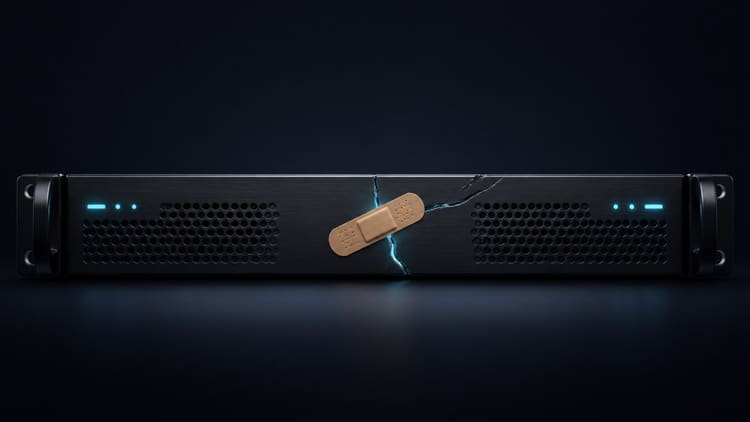
Patchday in the AI Era: The Pace Is Rising
Ai Security NetworkTable of Contents
Microsoft’s June Patch Tuesday sounded almost absurd at first: more than 500 CVEs, a record month, and the obvious question of whether large AI models are now being unleashed on software and suddenly finding vulnerabilities everywhere.
I had the same reaction at first. 500 does not just sound like a large Patch Tuesday. It sounds like a turning point.
After looking into it, my view is more sober, but actually more interesting: yes, June 2026 was a real record month. No, the 500 figure is not a clean value for “500 new Microsoft flaws that Windows admins had to patch on that Tuesday.” And yes, AI is very likely part of the new pace. But the more important question is not whether exactly 500 is correct.
The more important question is: what happens to IT operations when vulnerability discovery keeps getting faster?
If this pace keeps increasing, the second Tuesday of the month will no longer be the only patch day.
What really happened in June
On June 9, 2026, Microsoft released an unusually large security update. Depending on the source and counting method, the number of Microsoft CVEs was roughly between 198 and 209. Rapid7 counted 200. CrowdStrike counted 206. ZDI counted 208. Sophos spoke of 209 patches.
Those differences are methodically interesting, but they are not the core issue. Whether the final number is 198, 200, 206, or 209 Microsoft CVEs changes little in practice. Even the narrower Microsoft count was unusually high.
Ivanti called 198 Microsoft CVEs a new record and noted that October 2025, with 175 CVEs, had been the previous high. ZDI also wrote that June was the largest Patch Tuesday month since it started tracking these releases.
So this was not an inflated nothing. It was a real outlier. And that is exactly why we should not treat it only as a counting debate.
The more interesting trend is this: we are getting more findings, more sources, more affected product lines, more browser updates, and more third-party software demanding attention at the same time. Patch Tuesday is becoming less of a single event and more of a visible peak in a continuous stream.
Why the 500 figure still needs explaining
The 500 figure is not irrelevant. It shows how large the patch ecosystem has become. But it has to be explained, otherwise it leads to bad decisions.
Sophos put it neatly: 209 patches plus 388 advisories. ZDI reached a combined count of 571 CVEs when Chromium and other third-party issues were included. Ivanti also noted that Chrome and Edge addressed more than 500 CVEs around Patch Tuesday week.
That sounds dramatic. It is. But operationally, it has to be separated.
A large part of that 500 figure comes from Edge and Chromium. Rapid7 wrote that Microsoft had already addressed 360 browser vulnerabilities in June and that these were not part of the actual Patch Tuesday count. Sophos also explained that the 388 advisories were mainly Edge-related, mostly originated in Chrome, and were often patched before Patch Tuesday.
Adobe updates were also part of the picture. ZDI and Ivanti cited 123 Adobe CVEs in eleven updates. Sophos included Adobe and other advisory items in its own Patch Tuesday view.
That is the core:
- Microsoft Patch Tuesday in the narrow sense: roughly 198 to 209 Microsoft CVEs.
- Browser ecosystem: several hundred Edge/Chromium CVEs, some already shipped earlier.
- Third-party software: Adobe among others, with many CVEs of its own.
- Combined: a very large, but methodically mixed number.
For admins, this distinction matters. A Windows Server, an Edge client, Adobe Reader, a Defender signature level, and a cloud component are not the same patching task.
But we should not stop after sorting the number. Even when counted cleanly, the trend remains: there is more to watch, more to evaluate, and more to update.
The trend matters more than the exact number
We should not blindly repeat the 500 figure. But we should not dismiss it either.
The operational finding is stronger: even the narrower Microsoft count was near-record or record-breaking. And several June fixes were not the kind of topics you want to move casually into the next maintenance window.
ZDI highlighted, among other things, an actively exploited Defender flaw. CrowdStrike described several publicly known or especially critical vulnerabilities, including HTTP.sys, Windows Kernel, DHCP Client Service, and Active Directory Domain Services. Rapid7 wrote about HTTP.sys that Microsoft documented a public HTTP/2 denial-of-service issue and also addressed another HTTP.sys RCE with CVSS 9.8.
So even if the 500 headline is methodically broad, June remains a month where triage really matters.
Anyone who looks only at the total number sees too much and too little at the same time. Too much, because browser and third-party CVEs inflate the Patch Tuesday perception. Too little, because the important questions are not in the total count:
- Is the vulnerability actively exploited?
- Is it publicly known?
- Is an internet-facing service affected?
- Is there proof-of-concept code?
- Does it affect servers, clients, identity, browsers, or third-party software?
- Does the component update itself, or does it need a planned rollout?
That is where good patch management separates itself from CVE panic.
So what does AI have to do with it?
This is where things get interesting, but we need to stay precise.
In May 2026, Microsoft said quite clearly that AI is changing the speed and scale of vulnerability discovery. In an MSRC post, Microsoft wrote that both internal teams and the security community increasingly use AI to examine software more often and more thoroughly. Microsoft also said larger Patch Tuesday releases are likely for some time.
Microsoft became even more concrete in the post about MDASH, its own multi-model agentic scanning harness. There, Microsoft describes a system with more than 100 specialized agents that analyze code, debate findings, deduplicate them, and in some cases construct evidence. Microsoft says teams found 16 CVEs for the May Patch Tuesday with MDASH.
That is hard evidence that AI is no longer just a research toy. It has arrived in vulnerability discovery.
AI is a proven accelerator in the overall picture, even if it does not explain the June record on its own.
But that does not prove that the June record was caused by AI.
For June, there are individual concrete signals. Rapid7 writes that for CVE-2026-49160, an HTTP.sys denial-of-service flaw, Microsoft credits OpenAI Codex among the finders. That is notable because it is a CVE-level AI attribution.
What I do not see in the sources is a solid Microsoft statement saying, “June was this large because X percent of these CVEs were found by AI.” ZDI asks exactly that question as well and notes that Microsoft is not currently providing those answers.
My view is therefore:
AI is a proven accelerator in the overall picture. AI is visible in individual findings. AI is very likely part of the new volume reality. But AI is not cleanly proven as the sole or primary cause of the June 500 figure.
That is less spectacular than “AI finds 500 Microsoft flaws.” But it is more honest.
And for operations, that honest version is uncomfortable enough. If AI helps examine code faster, find variants faster, and rediscover old patterns faster, then not only the number of reports rises. The time organizations have to react after a fix also shrinks.
Why browsers distort the numbers
The browser part is almost the most practical part of the whole story for me.
Many organizations still think of Patch Tuesday as a monthly event: Microsoft releases updates, you test, roll out, and document. That still partly fits classic Windows and server updates.
Browsers work differently now. Chrome, Edge, Firefox, and others follow a more continuous update logic. If Chrome addresses hundreds of CVEs on June 3 and Edge follows as a Chromium-based browser, that appears in the June security week. But it is not the same work as an Exchange, Windows Kernel, or AD DS patch.
For MSPs and admins, that means you need two numbers.
The first is the narrow Patch Tuesday number. It answers: what do I need to prioritize around Microsoft products in my classic update process?
The second is the ecosystem number. It answers: what happened in the same period across browsers, Adobe, security components, developer tools, and third-party software?
Both numbers are useful. But mixing them creates bad decisions.
A customer hears “500 Microsoft flaws” and thinks of 500 Windows patches. An admin sees “200 Microsoft CVEs” and may underestimate that browsers had their own fireworks at the same time. Both views are wrong.
Fewer local tools are also a security strategy
This is exactly why I try to install as few local tools as possible on my Mac.
At first, that may sound like minimalism or a preference for order. For me, it is mostly patch management. Every additional tool is another piece of code that must be maintained. It has its own dependencies, update mechanisms, permissions, sometimes auto-updaters, background services, browser extensions, and local helper processes.
And every one of those components raises three uncomfortable questions:
- Does the developer even know about the vulnerability?
- Is there already a patch?
- Will that patch reliably reach me?
If an app is no longer maintained, the best CVE list in the world does not help much. I may eventually know something is vulnerable, but I still do not know whether it will be fixed properly.
That is why I prefer web apps over locally installed apps where it makes sense. That is not automatically safer. A web app can obviously have security issues too. But patch responsibility sits more with the provider, and I reduce the number of installed programs, updaters, and local attack surfaces on my own system.
This is not a religious rule. Some local tools are indispensable, especially in networking and security work. But I want a reason for every tool. “Nice to have” feels less and less convincing as patch velocity rises.
Patching becomes a continuous task
June 2026 does not simply show that there are more CVEs. It shows that the old monthly mindset is becoming brittle.
I would think about patch management in four lanes today:
First: classic Microsoft updates for Windows, Office, server roles, Exchange, SharePoint, Active Directory, and similar core systems. Here, maintenance windows, pilot groups, rollback plans, and clear prioritization by exposure matter.
Second: browsers and web clients. They should be in a continuous update lane wherever possible. Anyone still treating browsers like monthly Windows updates loses speed.
Third: security components such as Defender. Here you first need to check whether the affected component has already updated itself. Not every CVE in a June list means a manual rollout is still open on Patch Tuesday.
Fourth: third-party software. Adobe, PDF tools, developer tools, VPN clients, remote tools, communication apps, and utilities can create more operational work in the same week than Microsoft itself.
That sounds like more structure. That is the point.
If AI accelerates vulnerability discovery, it is not enough to click “install” faster. We need better triage.
The better question is not “how many?”
The number matters, but it is not the most important question.
For admins and MSPs, these questions are more valuable:
- Which systems are internet-facing?
- Which vulnerabilities are actively exploited or publicly detailed?
- Which updates affect identity, remote access, or server services?
- Which products update themselves and which do not?
- Which fixes need restarts or maintenance windows?
- Which systems are stuck because of legacy, application dependencies, or missing maintenance windows?
- Where do we still need to look for exploitation after patching?
Microsoft itself recommends this direction in the MSRC post: do not prioritize by raw count, but by exposure, impact, exploitability, and real-world exploitation.
That may be the most important lesson from June.
The raw number gets louder. Triage has to get better.
What I take from this for trueNetLab
I see the June Patch Tuesday as the operational counterpart to the recent AI security topics.
In Anthropic Mythos and Project Glasswing, the question was how well models can find vulnerabilities. In the bug bounty article, the point was that security teams will need harder evidence because good findings and AI slop are increasing at the same time.
The June Patch Tuesday now shows the operations side.
More vulnerabilities are found. More sources count differently. More components update outside the classic Patch Tuesday logic. And more people try to turn a large number into a simple story.
The simple story would be: AI now finds 500 Microsoft flaws per month.
The better story is: vulnerability discovery is getting faster, broader, and harder to communicate. AI is part of it. Browsers and third parties are part of it. Better counting methodology is part of it. And for admins, it becomes more important to turn a number into a reliable patch plan.
For me personally, there is one more point: the best vulnerability is the one I do not have to run locally in the first place. Fewer tools, less local attack surface, fewer update chains, fewer silent leftovers. That is not always convenient, because it means saying no to attractive apps more often. But in a world where patch velocity is rising, that discipline becomes more valuable.
My conclusion
500 CVEs in June are a good warning signal, but not a good operational unit.
Anyone who turns this into panic helps nobody. Anyone who dismisses it as a counting trick misses the trend. The truth sits in between: Microsoft’s June 2026 was genuinely unusually large, but the 500 headline describes a broad patch ecosystem, not only Microsoft patches. AI demonstrably accelerates vulnerability discovery, but for the June peak it is more of a plausible contributing factor than a proven sole cause.
For me, the consequence is clear: patch management must look less like a monthly ritual and more like continuous risk steering.
Not every CVE is equally urgent. But the time when large patch days could simply be processed as monthly routine is getting shorter.
And perhaps that is the real lesson from this June: not every day is already a patch day. But we are clearly moving in that direction.
Until next time,
Joe