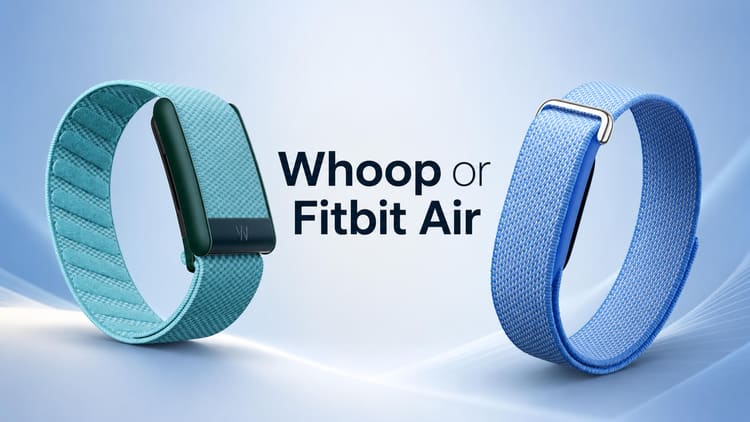
Fitbit Air vs. Whoop: The Sensible Alternative?
Health PersonalTable of Contents
I still find fitness trackers fascinating.
That may sound banal today, because almost everyone wears some kind of watch, ring, or band. But for me these devices still sit in that interesting space between technology, body awareness, and self-knowledge. A good tracker does not only tell me that I went for a run. It shows me how my body reacts to training, sleep, stress, food, illness, and bad decisions.
That is exactly why Whoop clicked with me back then. No display, no notifications, no tiny computer on my wrist. Just a sensor that measures 24/7 and tells me fairly clearly in the morning: you are ready. Or: maybe take it easier today.
And now Google is arriving with the Fitbit Air.
If Google builds a screenless tracker, the Whoop niche is no longer a niche.
Why the Fitbit Air is more than a new gadget
Google introduced the Fitbit Air on May 7, 2026. It is a small screenless tracker for 99.99 dollars, with up to a week of battery life, 24/7 heart-rate tracking, sleep tracking, HRV, SpO2, automatic activity detection, and three months of Google Health Premium.
That is the real point for me. This is not another tiny manufacturer trying to annoy Whoop. It is Google: a huge tech company that bought Fitbit, handled the brand somewhat unclearly for years, and is now launching a screenless tracker of all things.
It confirms what has been visible for a while. The market wants this category.
Amazfit tried to move in this direction with the Helio Strap. Polar has also pursued a displayless approach with Loop or Polar 360. Garmin is at least close to the category with the Index Sleep Monitor and the Cirqa rumors. Then there are Oura, Ultrahuman, RingConn, and Samsung with smart rings. They are not Whoop bands, but they sell the same idea: less display, more recovery, sleep, and body data.
All of them wanted to be the Whoop killer in their own way. Most of the time they were more like Whoop irritants: interesting, but not strong enough to push Whoop out of the center of the category.
Fitbit Air feels different. Not because Google automatically builds the best product, but because Google combines scale, price, app ecosystem, data platform, and consumer trust at once. For Whoop, that is a different type of opponent than one niche band.
Is the Fitbit Air really a Whoop killer?
Everyone is calling the Fitbit Air the Whoop killer right now. I find the phrase a bit loud, but not completely wrong.
For professional athletes, very ambitious athletes, and people who work with Recovery, Strain, Journal, Stress, Healthspan, and training control every day, Whoop is probably still the deeper system. Whoop is denser, nerdier, and more strongly built around optimization. The app has more data, the Recovery and Strain logic has been trained for years, and the accessory ecosystem with biceps bands, Bodywear, and on-body charging is simply further along.
But for many other people, that is no longer the decisive point.
For someone who is not a pro but wants to understand sleep, load, and recovery better, the Fitbit Air is probably the more sensible Whoop alternative. Buy it once, use the core metrics, optionally add Premium, but do not ask every year whether a tracker on your wrist is really worth a subscription of several hundred dollars.
That is the real Whoop-killer part for me: not maximum feature depth, but normalizing the idea without forced subscription logic.
The price is becoming personal
My Whoop subscription ends in September. And right now I am really not sure whether I will pay another 239 dollars per year.
Not because Whoop has become bad. Quite the opposite: some of the things I criticized in my last Whoop 5.0 article have improved. The Coach in particular has moved forward. Voice input and Speech-to-Text make that kind of coach much more natural. That was exactly what bothered me before: if I can already talk to an AI about my health data, I do not want to type every question into my phone.
So to be fair: Whoop is not ignoring feedback. The product is developing.
Still, the price remains. And it feels different when I no longer use Whoop as intensely as I did at the beginning. In the first phase I was constantly in the app: checking Recovery, looking at Strain, analyzing sleep, searching for patterns, enjoying better values, getting annoyed by worse ones.
Today I use it more calmly. Maybe more healthily. Maybe less consistently too. But when a product changes for me from daily biofeedback coach to a more passive tracker, 239 dollars per year suddenly hurts a lot more.
When tracking becomes stress
That is the second point on my mind: at the beginning, data motivates. Later it can start to stress you.
I know that feeling well. You wake up feeling basically okay, open the app, and see a red Recovery. Or your sleep score tells you before the first coffee that the night was supposedly bad. Suddenly you no longer interpret your body from your own feeling, but through a number.
Of course that can help. Trackers taught me a lot about sleep, training, HRV, and bad habits. But we should not pretend these devices only have positive effects.
Sleep research has a term for this: orthosomnia. People fixate so strongly on perfect sleep data that the tracker itself becomes part of the sleep problem. A 2024 study with 523 participants estimated orthosomnia prevalence between 3.0 and 14.0 percent, depending on the definition. Affected people had higher insomnia scores than the others.
Another study in the Journal of the American Heart Association looked at patients with atrial fibrillation. About one in five wearable users reported intense anxiety in response to rhythm notifications. That is not my sports use case one to one, but it shows the mechanism: a device that is meant to create safety can trigger control loops in some people.
And then there are softer but still interesting surveys. One widely cited consumer survey reported that 47 percent of fitness-tracker users had felt pressure, stress, or anxiety because their tracker pushed them to work out. That is not hard clinical evidence, but I recognize the everyday feeling immediately.
For me this means: tracking is good as long as it helps me make better decisions. It becomes unhealthy when I outsource my mood to scores.
The data problem bothers me even more
The price might be easier to accept if I felt that these data truly belonged to me.
With Spotify or Netflix I understand the subscription model. I pay for ongoing access to music or films that I do not own. If I cancel, the service is gone. That is logical.
Health data feels different.
If I collect years of sleep, HRV, resting heart rate, load, workouts, recovery, and body trends, that is not just content. It is my history. Maybe one day I want to give those data to my doctor. Maybe I want to analyze them with another AI. Maybe I want to combine them with Apple Health, Google Health, my own database, or some future health tool.
And that is exactly where Whoop bothers me.
Strictly speaking, it is not fair to say that all data disappear immediately when you stop paying. WHOOP’s terms say that an account becomes inactive after non-payment, that no new data can be uploaded from the device, and that historical data may remain accessible under some circumstances. There is also a CSV export in the app now.
But that does not change my basic feeling. The system remains strongly app- and membership-centered. Without an active subscription the tracker does not collect new usable data. The export is more of a data dump than a living, comfortable data space. And if I want to give these data to an external AI, I have to work with CSV files, APIs, gaps, and workarounds.
Google is not holy here either. It is Google, a data company. One should never be naive with health data just because the product is cheap. I would especially not assume that Google will keep my health data “forever” as a personal archive inside the app. Google documents export paths for Fitbit data, including activity, heart rate, sleep, sleep score, SpO2, Health Metrics, and more. But Google also has general inactivity rules for accounts and products, and the Fitbit-to-Google-Health transition has shown that data models and features can change.
The structural difference from Whoop still matters: with Fitbit Air, the core metrics continue to work without Premium. I am not paying every year just to keep the tracker useful at all. Apple Health is still more exemplary to me for data ownership because health data live on the device or encrypted in iCloud, and I have a lot of control over app access. Withings is even more open in many ways: exports, partner apps, and a public API make it easier to use data outside the company’s own app. Their subscription is becoming more aggressive too, but the data strategy currently feels much less closed than Whoop’s.
That is the most important difference for me. I do not want rental logic for health data, and I do not want blind trust in a cloud provider. I want to export, back up, and decide for myself who evaluates my data.
Why the Fitbit Air measurements are interesting
The test by The Quantified Scientist matters more to me here than many classic tech reviews, because it is not just a few days of walking around with a device followed by a feeling. Heart-rate data are compared with a Polar H10 chest strap, and sleep stages with an EEG-based reference device.
Rob is a postdoc working in biological data analysis. You can feel that in his videos. He does not test wearables like a normal influencer who receives a device, does a few workouts, and then has to stay friendly so the next manufacturer still invites him. He dissects the measurements, compares them with references, shows outliers, and says openly when a result is only preliminary.
I find that pretty cool because he understands the topic beyond the consumer view: heart rate, HRV, sleep stages, and statistical agreement. Of course his test is not a medical approval process either. But for consumer wearables, this kind of clean and transparent breakdown is much more valuable than a pure first impression.
His Fitbit Air result is surprisingly positive.
The sensor in the Fitbit Air apparently is not brand new. It resembles older Fitbit sensors from devices like Inspire 3 or Charge 5/6. Still, the Air does very well in his tests, probably because of Google’s signal processing and algorithms. Indoor cycling correlated with the reference at about 0.99, and running was also very high. Outdoor cycling was weaker, strength training was difficult as usual, and one hike produced a clear outlier.
That sounds like an honest picture to me: not perfect, but ridiculously strong for the price.
The sleep tracking is even more interesting. Against the EEG reference device, agreement was about 87 percent for deep sleep, 80 percent for light sleep, and 72 percent for REM. That is not medical perfection, but it is strong in the consumer category. Google/Fitbit lands in the same top group as Apple Watch, Whoop, Oura, and Eight Sleep.
And this is where it gets uncomfortable for Whoop: if a 99-dollar tracker without mandatory subscription is already good enough in the core metrics, Whoop has to explain its price premium very well.
What MKBHD took too lightly in my view
I like watching MKBHD. He is one of the few tech creators where you can feel a clear signature built over years. But in his Fitbit-Air-vs.-Whoop video I only half trust his judgment.
Not because the take is completely wrong. On the contrary, his broad framing has a point: Apple Watch is more like the easy entry, Fitbit Air is the middle, sensible option, and Whoop is the denser pro or enthusiast lane.
But the depth is not enough for me.
While watching, I had exactly this impression: MKBHD quickly compares it with a product that really needs to be worn longer. In the video he says himself that Whoop needs a longer calibration period for some functions. At the same time, the test period feels more like a hands-on than a real long-term test. Then there is the battery framing: Fitbit Air is advertised with up to one week, Whoop 5.0 with 14+ days. That is not just “a bit better”; in daily life it is a real difference.
I also find calorie comparisons between wearables weak as the main argument. Calories are notoriously difficult for consumer trackers and hard to compare cleanly across systems. If I compare Fitbit Air and Whoop, I care more about heart-rate quality, sleep analysis, recovery logic, data access, app interpretation, and whether the recommendations actually help in real life.
So I take MKBHD’s video as a useful first impression. For the actual judgment, I rely more on data-driven tests and on my own question: would I wear this thing every day and pay for it again every year?
Whoop still makes sense for some people
I do not want to talk Whoop down. That would be dishonest, because I learned a lot from it.
Whoop still makes sense if you are really deep into training control, Recovery, Strain, Healthspan, Journal, stress monitoring, and long-term body trends. If you wear the band on the biceps, track workouts cleanly, maintain the Journal, take your sleep routine seriously, and make real decisions from the data, Whoop is still a very strong system.
Especially at the beginning, Whoop can be extremely valuable. It almost forces you to see connections: eat late, sleep worse; train too hard, recover worse; lack routine, get worse values. After a year, however, you have understood many of these lessons. You know fairly well what you should do to stay fit: sleep regularly, move enough, train sensibly, stop romanticizing alcohol and junk food, and take recovery seriously.
At that point I may no longer need the full Whoop system every day. A Fitbit Air may be enough to keep an eye on the most important signals without making me justify an expensive subscription again every year.
For ambitious athletes, the missing display can also be an advantage. No distraction device, no mini smartphone, no rings begging to be closed. Just a sensor working in the background.
And yes: Whoop’s app is more mature. It often shows more numbers, more context, and more history at a glance than Google’s still-young Health Coach world. If money does not matter and you are training at a higher level, there are still good arguments for Whoop.
I respect that.
I am just not sure whether I am still exactly that user.
Who Fitbit Air is more sensible for
Fitbit Air is not the tracker for someone who wants to squeeze maximum performance out of every training block.
It is the tracker for people who want a calmer health gadget. For people who do not want to wear a smartwatch on the second wrist. For people who want to understand sleep, HRV, resting heart rate, activity, and Cardio Load without being pushed into an expensive subscription. For non-pros who want a solid, discreet, and affordable version of the Whoop idea.
That is why “Whoop killer” is loud, but not completely absurd.
Fitbit Air does not kill Whoop among the pros. It kills Whoop where Whoop may have become too expensive, too closed, and too intense: among people who simply want better health data and do not want to feel like they are wearing a small performance SaaS product on their body.
Maybe GoPro is a useful warning here. GoPro was almost synonymous with action cameras for a long time. The name says it already: Go Pro. But not everyone is a pro. At some point, a very strong brand became a difficult market because many people wanted good cameras, but not a pro setup, not a special ecosystem, and not the next small upgrade every year.
I see a similar risk for Whoop. The brand is strong, the data are good, and the product is exciting for very ambitious users. But if Google, Fitbit, Apple, Withings, Garmin, Oura, and others deliver good-enough health signals for normal people, the question becomes harsher: how many people are truly “Whoop-pro” enough to justify an expensive specialist subscription long term?

My preliminary conclusion
I have not completely decided yet. My Whoop subscription runs until September, and until then I want to see how Fitbit Air, Google Health, and possible long-term tests develop.
But my direction has become clearer.
Whoop is still strong. Very strong, even. But the question is no longer whether Whoop is technically good. The question is whether Whoop is still worth 239 dollars per year for my current everyday life. And whether I feel comfortable with a system where my health data are exportable, but in practice still live strongly inside an app and a subscription.
Maybe the Apple Watch will become more interesting in this discussion again at some point. In recent years, however, the device has not really evolved that much for me. In everyday life, the Apple Watch does not measure pulse permanently every few seconds, but at intervals depending on the situation. During an activity it becomes much denser, but as a 24/7 health tracker it is a different approach than Whoop or Fitbit Air, which are much more focused on continuous background tracking.
Honestly, a tracker would not have to be displayless for me. I have enough discipline not to stare at the screen all the time, and the Apple Watch is already on my other wrist anyway. If Apple clearly improved sleep, recovery, battery life, and more continuous measurement, that would actually be attractive to me: one device fewer. But the Apple Watch battery is often too quickly at the end. To really replace Whoop or Fitbit Air in this role, it would need a major hardware update in my view. Apple probably has enough other problems right now.
Fitbit Air is not the perfect Whoop killer. But maybe it is something better: the sensible Whoop alternative for normal, health-conscious people who are not professional athletes.
And honestly: maybe that is exactly the version of health tracking I need right now. Less extremism. Less subscription pressure. Less score stress. But still enough data to understand my body better.
Until next time,
Joe
Sources
- Google Blog: Introducing the all-new Fitbit Air
- Google Health Help: How do I export my Fitbit data?
- Google Account Help: Inactive Google Account Policy
- WHOOP Terms of Use
- WHOOP Support: How to Export Your Data
- Apple Support: Back up your Health data in iCloud
- Withings Support: Exporting my data
- Withings Developer: Public API
- Nasdaq: GPRO Historical Data
- The Quantified Scientist: Fitbit Air Ultimate Scientific Review
- MKBHD: The Truth About the “Whoop Killer”
- Baron et al.: Orthosomnia: Are Some Patients Taking the Quantified Self Too Far?
- Jahrami et al.: Prevalence of Orthosomnia in a General Population Sample
- Rosman et al.: Wearable Devices, Health Care Use, and Psychological Well-Being in Patients With Atrial Fibrillation