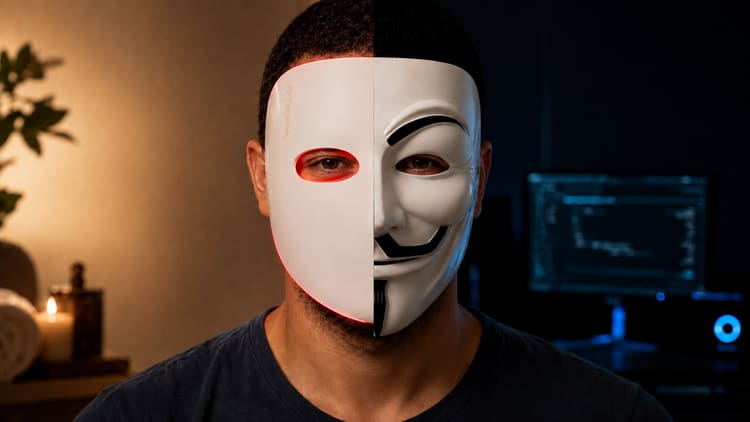
My Skincare Routine: Skin Cycling, CeraVe, and LED Masks
Health PersonalTable of Contents
I generally write here about the things that occupy my life. Security and networking are a big part of that, no question. But away from the nerd stuff, my free time also revolves around food, sport, sleep, and trying to treat my body somewhat sensibly. For me, all of that belongs in the health category. Still, a few years ago I probably would have laughed if someone had told me I would voluntarily write about skincare: cleansing gel, moisturizer, retinol, and LED masks?
It still fits. Unfortunately, I only started paying more consistent attention to my body at around 34. That was roughly when fitness, health tracking, vegan nutrition, and biohacking started becoming more mainstream. Before that I still had a young body that forgave a lot: bad sleep, little movement, too much screen time, poor food. You notice it somehow, but your body does not send the bill immediately.
The older I get, the clearer it becomes: that bill arrives. If I skip back exercises, I get back pain. Bad sleep shows up in my data and in my head. When training, nutrition, and routines collapse, I feel it across the whole system, not just on the scale.
And yes, with age I am becoming a little vain too. Not in the sense of perfection, but in the sense of: if I am already trying to live healthier, why would I completely ignore my skin?
If you know my health posts, you know the pattern: I no longer want to run my body purely by feel. I have written about fitness gadgets and health data, about Whoop 5.0, and also honestly about being completely out of my routine. Skincare is not a beauty-influencer moment for me. It is the same logic: small, repeatable steps that do more over time than frantic rescue attempts.
For me, skincare is not perfectionism. It is a simple routine with a small gadget factor.
First, a short disclaimer
I am not a dermatologist. This is my personal routine and technical view, not medical advice. If you have skin disease, severe acne, melasma, or light-sensitive skin, I would clarify it with a dermatologist first.
With LED masks, I also treat light with respect. It is not a toy just because it looks like wellness. I would not blindly use blue light every day, especially with darker skin types, melasma, or a tendency toward hyperpigmentation.
Why Skincare Belongs Here
Fitness trackers now guide you fairly well through movement, sleep, and recovery. Nutrition is also relatively well researched. We roughly know what we should do: enough protein, not only junk food, not eating too late, enough water, enough sleep.
I was less consistent with skincare for a long time. Maybe because the topic quickly sounds like a beauty shelf. But skincare is actually very sober:
- cleanse
- add moisture
- avoid UV damage
- dose active ingredients sensibly
- do not do everything at once
That does not sound spectacular. But that is exactly what I like about it now. It is like training: the perfect special exercise is not what makes the difference. Doing the basics long enough does.
A video by Dr Dray confirmed this well for me: a good morning routine does not need ten products. Hydration, sunscreen, and a cleanser your skin tolerates matter more than constantly adding new actives.
The Trucker Case: UV Protection Is Not Optional
One image that immediately made the topic real for me is the well-known NEJM case of unilateral dermatoheliosis. It describes a 69-year-old delivery van or truck driver who had driven professionally for 28 years. Over roughly 25 years, one side of his face developed much heavier thickening and wrinkling. The explanation: years of UVA exposure through the side window.

I find this image powerful because it pulls UV damage out of the abstract. It is not just about sunburn at the beach. UVA plays a major role in photoaging and can also matter through glass.
Here in sunny Dubai, I therefore take UV protection seriously. I have worn UV clothing consistently for years and use sunscreen. In everyday life my daytime cream with SPF 30 is often enough. If I am outside for longer, I generally use SPF 50.
My Morning Routine
Morning has to be simple. If a routine becomes too long, it will not survive bad nights or stressful days.
1. Cleansing
I start with a mild CeraVe cleansing gel for facial cleansing. The point is simple: remove sweat, sebum, and leftover night care without unnecessarily drying out the skin.
I do not want aggressive cleansing in the morning. No hot water, no scrubbing, no squeaky-clean feeling. If the skin feels tight after cleansing, it was probably too much.
2. Vitamin C
Then I use a vitamin C serum. I see vitamin C in the morning as an antioxidant layer. It does not replace sunscreen, but it fits well before SPF and may help long-term with tone, pigmentation, and collagen-related concerns.
Important: I do not treat vitamin C like an instant filter. If the skin burns, becomes very red, or is already irritated, I would pause it or use a gentler dose.
3. Day Cream With SPF 30
In everyday life I use CeraVe day cream with SPF 30. It combines moisture and UV protection, which is practical for me because one fewer step means I actually do it.
If I am outside for longer, especially in Dubai, I additionally or instead use SPF 50. Then it is no longer about a bit of care, but real protection: reapplying, shade, UV clothing, sunglasses.
A good reminder from dermatological routines: sunscreen does not stop at the forehead. Neck, ears, lips, and depending on clothing, hands also get sun. With pigmentation tendency or melasma, a tinted sunscreen with iron oxides can also make sense because it helps against visible light too.
| Step | Product | Why |
|---|---|---|
| Cleansing | CeraVe cleansing gel | mild cleansing |
| Treatment | Vitamin C serum | antioxidant, tone, pigmentation |
| Everyday | CeraVe day cream SPF 30 | moisture and UV protection |
| Outdoor/Dubai | SPF 50 | stronger sun protection |
| Lips | balm or occlusive care | prevent dryness |
My Evening Routine
Evening is about cleansing, active ingredients, and repair. This is where it is easy to do too much. Retinol, acids, peels, LED, masks, toners, serums: at some point it is no longer skincare, but stress for the skin.
1. Cleansing After the Day
If I wore SPF, I cleanse thoroughly in the evening. On normal days my CeraVe cleansing gel is enough. If a lot of sunscreen or makeup were involved, I would first dissolve it with an oil or balm cleanser and then cleanse again with CeraVe.
The point is: clean, but not stripped.
For stronger acne, a cleanser with salicylic acid can make sense. In my routine, I prefer to keep this separate: mild cleansing as the base, active ingredients targeted through the CeraVe Anti-Blemish Gel.
2. Active Ingredient or Pause
Not every evening needs an active ingredient. I roughly distinguish between three kinds of evenings:
- exfoliation or blemish night
- retinol night
- recovery night
For blemishes I use CeraVe Anti-Blemish Gel. It contains salicylic acid as a BHA and AHA ingredients such as glycolic and lactic acid. This can help with clogged pores and texture, but for me it does not belong under retinol on the same evening.
I see retinol as a long-term active for texture, fine lines, pigmentation, and blemishes. But retinol is not a “more helps more” product. Especially at the beginning: slowly, rarely, and with good moisturizing care.
3. Evening Moisture
To finish, I use my CeraVe moisturizing cream. That is my evening base: ceramides, moisture, barrier care, no fragrance show.
Especially after an active night, the cream matters. Actives without barrier care are like training without recovery: you can do it, but eventually it catches up with you.
Skin Cycling: My Order System
Skin cycling is simple at its core: active ingredients and recovery nights are separated. That way, you do not stack everything on your face every evening.
My simple model:
| Night | Focus | What I do |
|---|---|---|
| 1 | Exfoliation | cleansing, CeraVe Anti-Blemish Gel, moisture |
| 2 | Retinol | cleansing, retinol, moisture |
| 3 | Recovery | cleansing, CeraVe moisturizing cream |
| 4 | Recovery | cleansing, CeraVe moisturizing cream |
Then the cycle starts again. If my skin is dry, irritated, or sensitive, I extend the recovery phase. For me, skin cycling is not a trend word. It is a rate limiter. It prevents the routine from escalating.
The Most Important Don’ts
Do not start everything at once. If vitamin C, retinol, acids, and an LED mask all arrive in the same week, you no longer know what caused irritation.
Separate retinol and acid exfoliation. Some skin can handle a lot. My routine does not need to prove how much irritation is possible.
Do not scrub. I do not need harsh scrubs, aggressive brushes, or hot water.
Do not forget SPF. Without sunscreen, the most important lever against photoaging and pigment spots is gone.
Pause when skin is irritated. If the skin burns, flakes, or feels tight, it does not need more actives. It needs less.
LED Masks: The Gadget in the Bathroom
Now the tech part. LED masks are exactly the kind of product that wakes up my inner nerd. It lights up, has modes, wavelengths, timings, batteries, and manufacturer diagrams. Of course I want to know whether there is more behind it than marketing.
LED light therapy, often called photobiomodulation, uses specific light ranges to trigger processes in the skin. The short version:
| Light | What it is used for | My view |
|---|---|---|
| Red | fine lines, texture, redness, collagen support | my standard mode |
| Near-infrared | deeper regeneration, inflammation, healing processes | interesting as an add-on |
| Blue | acne, antibacterial effect | targeted only, not as constant light |
| Amber/yellow | often marketed for redness and skin tone | nice, but not my main reason |
The expectation matters: LED does not replace a basic routine. It does not replace SPF, retinol, cleansing, or moisture. It is an add-on.
Why I Chose Qure
In the end, I chose the Qure Q-Rejuvalight Pro Facewear. I had also looked at the Therabody TheraFace Mask, Dr. Dennis Gross DRx SpectraLite FaceWare Pro, and the CurrentBody Skin LED Mask.
Therabody still appeals to me as a gadget: many LEDs, red, near-infrared, blue, and vibration. That is very much health tech in the bathroom. For my everyday life, though, it was too expensive, too massive, and a bit too much of a “big device” that you then really have to use consistently.
Qure was the better compromise for me. The mask is lighter, more flexible, the application is short, and the app or zone control fits my way of thinking. I do not want to blindly run all modes every day. I want to decide what I am doing. Especially with the blue-light topic, that control matters to me.
The most important reason was banal: an LED mask only helps if you actually use it. Three minutes are more realistic than a ritual that feels like a major appointment every time. That is why Qure was the more realistic choice for me.
My conclusion on LED masks: the best device is not automatically the one with the most LEDs. The best device is the one you use correctly, regularly, and without stressing your skin.
Blue Light and Hyperpigmentation
I see red light and near-infrared more as anti-aging and recovery tools. Blue light is different. It is mainly used for acne because it can influence acne-related bacteria.
But I would not use blue light every day just because the mask has that mode. Visible, shorter-wavelength light can matter when pigmentation is an issue. I would be careful with darker skin types, melasma, or post-inflammatory hyperpigmentation.
My rule:
- red/near-infrared: more of a standard
- blue: only targeted for acne
- melasma or pigmentation tendency: avoid Blue Mode or clarify first
- pigmentation concerns: consider tinted SPF with iron oxides during the day
- irritated skin: pause LED
Where LED Fits Into My Routine
If I use LED, I use it after cleansing on dry skin and before serums or creams.
Morning would be:
- CeraVe cleansing gel
- LED, preferably red/near-infrared
- Vitamin C
- CeraVe day cream SPF 30 or SPF 50
- Do not forget neck, ears, lips, and hands
Evening would be:
- Cleansing
- LED
- Skin-cycling step or recovery
- CeraVe moisturizing cream
I would stick to the manufacturer time. More minutes do not automatically mean better results.
What I Take From Bryan Johnson
Bryan Johnson is, of course, the extreme case of this whole health-optimization bubble. Yet his protocols still mention surprisingly normal foundations: cleansing, sunscreen, moisture, vitamin C, niacinamide, tretinoin, and red light.
That confirms it for me: even in the maximum biohacker setup, the basics remain the basics.
What I take from it:
- sleep, nutrition, and sport remain central
- UV protection is non-negotiable
- red light can be one building block
- measurement helps, but you should not get lost in measurability
What I do not take over is the full radicalism. I do not want skincare that manages my life. I want a routine that works in real weeks.
My Routine in Brief
Morning
- CeraVe cleansing gel
- Vitamin C serum
- CeraVe day cream with SPF 30
- SPF 50 when I am in the sun for longer
- Do not forget neck, ears, lips, and hands
Evening
- CeraVe cleansing gel
- Skin cycling: exfoliation, retinol, or recovery
- CeraVe moisturizing cream
- LED optional after cleansing and before skincare
This is not a ten-step routine. Deliberately not. I want to be able to do it even when I am tired. Consistency beats complexity.
My Conclusion
Skincare now feels less like vanity to me and more like maintenance. Not in a cold way, but in a good one: I am taking care of a system that protects, regenerates, and visibly reflects how I treat myself every day.
The basics are simple: cleanse, moisturize, sunscreen, targeted actives, do not overdo it.
The LED mask is the tech bonus. Interesting, yes. But not a substitute for discipline. If you do not use SPF, you do not need an expensive LED mask first. If you stack actives every night, you do not need more light. You need more recovery.
For me, skincare fits well into my health journey. Not as a religion. Not as a perfect routine. But as another attempt to live healthier and not only react when everything is already out of rhythm.
Until next time,
Joe
FAQ
What is skin cycling?
Can I use retinol and AHA/BHA on the same evening?
When do I use an LED mask?
Is blue LED light problematic for darker skin types?
Sources
- American Academy of Dermatology: Is red light therapy right for your skin?
- American Academy of Dermatology: Melasma self-care and tinted sunscreen
- PubMed: Images in clinical medicine. Unilateral dermatoheliosis
- NCBI Bookshelf: Melasma
- Cleveland Clinic: LED Light Therapy
- Cleveland Clinic: Best ingredients and products for an anti-aging routine
- Ohio State Health & Discovery: A step-by-step guide on how to skin cycle
- CeraVe: AM Facial Moisturizing Lotion SPF 30
- CeraVe: Acne Control Gel
- Therabody: TheraFace Mask
- Qure: Q-Rejuvalight Pro Facewear
- Dr. Dennis Gross: DRx SpectraLite FaceWare Pro
- CurrentBody: Skin LED Light Therapy Mask
- Blueprint Bryan Johnson: My New Skincare Protocol 2025
- Dr Dray: A Dermatologist shows her MORNING SKIN CARE ROUTINE