Why I Am Cancelling My Whoop Subscription After Two Years
Health PersonalTable of Contents
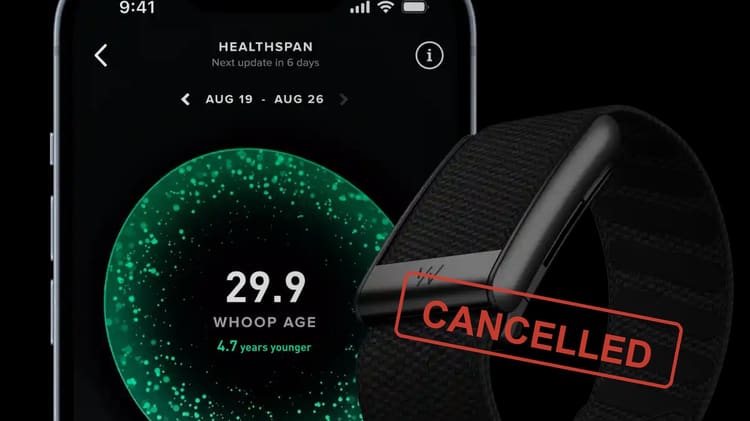
In September, Whoop is over for me.
After two years, I am cancelling my subscription. Not because the band is bad. Not because the app has become useless. And not because I have suddenly turned against fitness trackers. Quite the opposite: I still find health tracking extremely interesting.
But Whoop has reached a point for me where the product has basically done its most important job.
It taught me routines. It showed me how sleep, training, stress, food, recovery, and heart rate variability are connected. It motivated me for a long time. It gave me numbers I did not have before. And exactly because of that, I need it less today than I used to.
For two years, Whoop was a very good learning tool for me. But a learning tool does not have to stay a subscription forever.
Why Whoop Was Interesting To Me Back Then
When I started using Whoop about two years ago, the band still felt genuinely special to me.
Of course, the Apple Watch, Garmin, Fitbit, Oura, and many other devices already existed. But Whoop had a very clear idea: no display, no notifications, no smartwatch, no distraction. Just a sensor band that measures the body in the background and turns that into strain, recovery, and sleep insights.
I liked that.
Many years earlier, I had already used a small Fitbit. It was a thin band with a tiny screen, mostly for steps and basic activity data. I really liked that device. It was discreet, light, and gave me the feeling that I understood my daily life a little better.
The problem back then was Fitbit itself. The app was very closed, and the data did not end up in Apple Health the way I wanted. For me, this was already a fundamental issue: health data should not be locked inside one manufacturer’s app.
When Apple established a central health data model on the iPhone with HealthKit and Apple Health, that felt like a big step to me. I want to collect my data in one place. I want to be able to export it. I want to keep it long term. If necessary, I want to give it to a doctor or later analyze it with another app, my own database, or an AI.
At the time, Whoop felt like a more modern version of that old Fitbit feeling: thin, without a display, with much more sensor technology and much more context.
In my older article Fit With Technology: The Continuous Optimization Of My Health, I described exactly that phase. Back then, Whoop was a valuable addition to the Apple Watch for me. The Apple Watch collected data and closed rings. Whoop was more about explaining what that data might mean for recovery, training, and sleep.
What Whoop Really Taught Me
The biggest value of Whoop for me was not that I received a number every morning.
The value was that I learned connections over months.
I learned how strongly sleep consistency affects my recovery. I learned that eating late can worsen my resting heart rate and night values. I saw how regular Zone 2 training affects my fitness. I understood why intense sessions, too little sleep, and bad stress are not isolated events, but reinforce each other.
Later, I found Whoop Age, or Healthspan, especially motivating. For me, that was genuinely one of the strongest features Whoop introduced. Not because I believe one single number can perfectly describe my real biological age. But because the presentation was immediately understandable.
You see what you need to work on.
More sleep consistency. More training in sensible zones. Better VO2 max. Lower resting heart rate. More strength training. Fewer phases where you sabotage yourself. This supposed biological age was less a medical truth for me than a very good motivator.
What I liked was that Whoop did not only say: you collected data. It said: these are the habits that make you look younger or older over the long term.
That is why I was still quite positive in my Whoop 5.0 article. The hardware improved, the battery became much stronger, Healthspan became more interesting, and the app felt more like a real health system.
But after two years, something interesting happens: you know the lessons.
I now know how often I need to run. I know which training zones are good for me. I know that I must not ignore strength training. I know that sleep is not an optional bonus. I know my typical mistakes. I know the patterns Whoop kept showing me.
And once you have internalized these routines, you no longer need an expensive special device every day to tell you the same truth again and again.
This Is Where The Value Changes
This is the central point for me.
At the beginning, Whoop was a coach. Today it is often just a confirmation system.
I open the app and see something I mostly already know. Bad night? I feel it. Good recovery? I feel it. Too little training? I know. Too much stress? Unfortunately, I know that too.
Objective data is valuable, of course. I do not want to live completely without tracking in the future either. But the difference between “I am currently learning my body” and “I am seeing the familiar patterns again in an app” is big.
And when that difference gets smaller, the price gets bigger.
Whoop is not cheap. Depending on the plan, you pay an amount year after year that could also buy, test, and replace other trackers. That would be less of a problem for me if Whoop had no competition. But that is no longer the case.
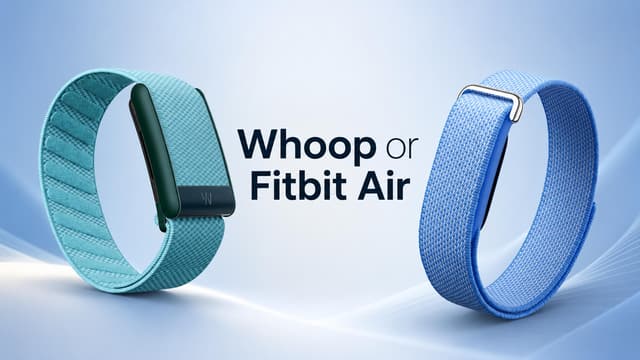
With the Fitbit Air, a new chapter has opened for me. Google has shown that the idea of a displayless tracker no longer belongs exclusively to Whoop. Other providers are moving in the same direction. Some with rings, some with bands, some with watches that focus more on health tracking than on classic smartwatch features.
But I am not making a data exception for the Fitbit Air either. I find the device interesting because Google is entering exactly this market with it. But the Google Health app does not automatically solve my Apple Health problem. Quite the opposite: knowing Google, it is more likely to read all kinds of data out of Apple Health while writing nothing truly useful back. At least Fitbit data can generally be exported from the Google ecosystem. Still, for me that would not be the perfect open solution, but rather a different data space.
The market has understood that many people do not want a second display on their body. They want data. Sleep. Recovery. Heart rate. HRV. Training load. Maybe some AI context. But they do not necessarily want to pay for a luxury subscription every year just so the sensor remains useful.
The Data Problem Is The Real Break For Me
The price bothers me. But the data model bothers me almost even more.
I am sensitive about health data. Not paranoid, but conscious. When I collect values over years, this is not a playlist and not a Netflix history. It is the history of my body.
I want to be able to keep this data in an external system long term. Apple Health is still an important anchor for me because it works as the central health database on the iPhone and because many apps can access it if I allow them to. Technically, behind it in the Apple ecosystem is a local or synchronized health data base that I can export and combine with other tools over time.
That is exactly what I want.
I do not only want to see a beautiful app today. I want to be able to understand in five, ten, or twenty years how my resting heart rate, HRV, cardio fitness, training frequency, and sleep quality have developed.
Whoop does write data to Apple Health. For me, that includes among other things:
- Active energy
- Respiratory rate
- Blood oxygen
- Heart rate
- Resting heart rate
- Sleep
- Steps
- Workouts
That is not nothing. These are important values.
But many of the values that really interest me long term are missing, or do not land in Apple Health in the form I would like. For me, that mainly includes heart rate variability, cardio fitness or VO2 max, and certain Healthspan or biofeedback values that you want to improve over months and years.
To be honest, steps hardly interest me. Whether I had 8,000 or 10,000 steps is nice. But it is not the value I wear a Whoop for.
I want to be able to export the signals that really say something about my condition and my development. HRV. Recovery. Strain. Cardio fitness. Trends. Not only the simple basic data.
And this is where Whoop feels too closed to me.
Whoop Without A Subscription
That is exactly why I am also taking a closer look at Noop. Apparently I was not the only one with this thought: the Whoop band is interesting hardware. The subscription was fine for me for two years, but over the long term the subscription model and the closed data world bother me more and more.
For me, Noop is an interesting example of what open source can do today. A community takes a good piece of hardware and separates local access to the sensor data from the subscription logic. Not to rebuild Whoop in a prettier way, but to follow a different basic idea: the band belongs to me, the biometric data is created on my body, so I should also be able to read, store, and analyze it locally on my own device.
Noop connects directly to the Whoop band via Bluetooth, stores the data locally, including in a SQLite database, and works without a Whoop account, without the Whoop cloud, and without an active Whoop subscription. That is exactly what makes the project interesting: it shows that the actual sensor does not automatically have to become worthless just because you no longer want to pay for the service behind it.
The fact that projects like this can even emerge today surely also has to do with the current developer world. With AI support, Vibe Coding, and a motivated open-source community, it is easier than ever to turn a good idea into a usable tool very quickly. In the past, a project like this would have failed for many people at app UI, platform code, Bluetooth handling, or database logic alone. Today, a small community can show much faster that an alternative is possible in principle.
What happened around the project is also interesting. According to the Noop project, the entire GitHub account was temporarily suspended without warning: code, releases, Homebrew tap, and iOS source were gone in one stroke. I did not find a confirmed lawsuit from Whoop. But a look at the Whoop Terms of Use shows why a project like this quickly moves into a legally delicate area: Whoop permits use of the embedded software only as part of its own services, ties many usage rights to an active membership, generally prohibits reverse engineering of the services or software, and also prohibits use of the Whoop Device for purposes other than the Whoop Services.
That does not automatically mean that every form of local interoperability is illegal or that Noop specifically violates applicable law. Especially in Europe, contractual prohibitions and statutory interoperability rights can be assessed differently depending on the case. But from Whoop’s perspective it is clear why the company would not support such projects: they touch exactly the business model in which hardware, firmware, app, cloud, and subscription are designed as one closed system.
Publicly, the GitHub case sounds more like a platform suspension without a clear explanation, possibly triggered by an automated abuse or bot flag. Still, the move to its own infrastructure is part of the story for me: anyone building an independent tool against platform and subscription lock-in should not themselves depend on a single platform provider.
Still, you have to be fair: with wearables, the app is not the only decisive part. Firmware and analysis logic are at least as important. With Whoop in particular, I had the impression that the readings were not always perfect at the beginning. There were outliers, and under certain loads the heart rate values did not seem as close to the more realistic reference value from a Polar chest strap as I would have liked. Over time, firmware updates improved that. The outliers became fewer, and the values moved closer to what a more accurate chest strap measured.
This is exactly where open source becomes harder. Building an app, storing data locally, and rendering dashboards is one thing. Interpreting sensor values cleanly over time, handling firmware changes, and improving algorithms for years so that they really move closer to good reference devices is another. For now, that is probably not as easy as it is for a manufacturer that controls hardware, firmware, data model, and app completely.
Not yet.
And still, I think Noop is very cool. Not as a finished replacement for everyone. Not as a medical tool. And not as a blanket recommendation. But as an idea, it is exactly the direction I would like to see more often in the health tracking market: good hardware, less platform lock-in, more data ownership, and more local control. I will keep an eye on the project and probably test it myself.
If I Stop Paying, The Device Is Practically Devalued
This is the point that always comes with a subscription tracker.
If I no longer pay for my Whoop subscription, the hardware physically stays with me. But the actual value depends on the service. Without an active subscription, the band is no longer the health tool I bought it for.
That would be logical with music or films. I pay Spotify or Netflix for as long as I use the service. If I cancel, the content is gone. That is the business model.
With body data, it feels different.
If I imagine wearing Whoop, as the manufacturer would like, until old age, then at some point we are no longer talking about a gadget. We are talking about many thousands of dollars for a data archive that primarily lives in one manufacturer’s app. Depending on plan and time period, over decades you very quickly end up above 10,000 dollars.
And even then, this data is still not as freely usable as I would like for my health.
Yes, there are export paths. Yes, there are now unofficial tools and community projects that try to make Whoop data usable more locally and independently. I find that interesting because it hits exactly this nerve: people want to analyze their own sensor data on their own systems.
But an open-source workaround is not a substitute for a clean product philosophy.
I do not want to depend on a community project reverse-engineering what the manufacturer should actually offer openly. Especially with health data, exportability should not be a nerd extra. It should be a basic right of the product.
The AI Point Is Becoming More Important
With the Coach, Whoop understood early that health data and AI go well together.
That is basically strong. If a model can access my sleep, training, and recovery data, it can answer much better questions than a generic fitness app. It can explain patterns, suggest training, and sometimes simply help translate all those numbers into a concrete next step.
But that makes the data problem even more visible.
If my data is only useful inside the Whoop app, then the AI analysis is also tied to Whoop. I cannot simply take my preferred model, feed it my long-term data cleanly, and ask my own questions. I cannot freely decide whether I want to use Apple Health, a local SQLite database, my own export, a research app, or another analysis tool.
That is not the direction I want to go in.
For me, health tracking will become much more data-driven and AI-supported in the coming years. Not necessarily because every app needs a chatbot. But because individual health data only becomes truly interesting when you can combine and query it over long periods.
Which training phases improved my HRV? How strongly does late eating correlate with my sleep? What happens to my resting heart rate if I run consistently for two weeks? Which routines actually work for me, and which ones am I just imagining?
For questions like these, I want open data.
Not just a pretty app.
Apple Has Disappointed Me Here For Years
Actually, Apple would be the perfect provider to solve this problem for me.
I wear an Apple Watch anyway. Apple Health is my preferred data hub. Apple has privacy as part of its brand core. Apple has the hardware, the sensors, the operating system integration, the developer platform, and the user base.
And still, Apple’s health area has felt surprisingly sleepy for years.
Yes, every year one or two new features arrive. Yes, the Apple Watch is a good device. Yes, it is very strong in many measurements. But for my specific purpose, namely collecting and analyzing my health data over the long term, Apple has given me hardly any reason in recent years to replace my old Watch.
My Apple Watch Series 6 is now almost six years old. For a wearable, that is a lot.
Still, so far there has been no compelling reason for me to buy a new Apple Watch.
That really says it all.
The battery is my biggest problem. My Series 6 sometimes tells me as early as 3 p.m. that it barely has any energy left. Of course, the watch is old, and the battery has suffered. But this is exactly where I appreciate Whoop a lot. With Whoop 5.0, the roughly two weeks of battery life are genuinely pleasant in everyday life.
I do not absolutely need two weeks. But four to five days would already be a huge step forward for me on an Apple Watch.
And honestly: I still hope a little that Apple will eventually wake up from this deep sleep. The hardware competence is there. What I am missing are better batteries, bolder form factors, and maybe even a displayless Apple Health band.
I do not know whether something like that will come. For September, I do not really expect a revolution. Apple is slow, and even if more hardware courage emerges internally, you rarely see it immediately in the next product generation.
But the hope remains: if Apple built a discreet band without a display, with long battery life, good sensors, and complete Apple Health integration, I would probably be interested immediately.
I Am Not A Professional Athlete
Another important point is this: I am not the target group that best justifies Whoop.
I am not a professional athlete. My job is something else. I do not train for several hours every day. I plan my life with time blocking, and my training windows are limited.
Realistically, I maybe have two mornings or two evenings per week when I can really run or train in a structured way. The rest is work, projects, appointments, family, everyday life, and all the things that are also important.
That means: I do not need permanent high-performance steering.
A top athlete who pushes limits every day benefits much more from knowing exactly when the body is ready, when recovery is missing, and how far it can be pushed. There, Whoop can be a real performance system.
For me, it is more of an everyday and health tool.
And for that use case, a cheaper or at least less subscription-heavy system is probably enough for me today. I still need good data. But I do not necessarily need the most expensive special subscription on the market.
What I Am Doing Instead
My Whoop subscription runs out in September. Until then, I will keep wearing the band.
I do not yet know which device will come after that. The Fitbit Air is currently one of the most interesting Whoop alternatives for me because it picks up the same basic idea: no display, continuous measurement, focus on health instead of notifications. But I do not have a Fitbit Air and am not currently planning my own test. What interests me most is that Google is entering this market and hopefully putting pressure on Apple. From a data policy perspective, the Fitbit Air is not automatically better for me. I already wrote about exactly that in the article Fitbit Air vs. Whoop: A Sensible Alternative?.
But I do not want to commit finally yet.
In September, new iPhones and new Apple Watch models usually arrive. Maybe Apple will surprise me. Maybe not. Maybe I will look at other trackers. Maybe in the end it will still be an Apple Watch solution if the battery and health features finally get better.
The decisive point is: for the price I save on Whoop, I can easily test other trackers.
That feels healthier to me than another year of subscription out of habit.
My Conclusion After Two Years With Whoop
I do not regret Whoop.
Quite the opposite. Whoop was exactly the right tool for me in an important phase. It motivated me to improve my routines. It showed me how strongly sleep, training, and recovery are connected. It helped me judge my body not only by gut feeling.
But after two years, the learning effect has become smaller.
I have understood the routines. I know the most important levers. I know what I need to work on. And I also know that I am not a professional athlete who has to squeeze maximum performance out of his body every day.
At the same time, the price remains high, the data lock-in is strong, and the export logic is unsatisfying for me.
That is why my Whoop experiment ends in September.
Not in frustration. More with the feeling: thank you, you did your job. But now it is enough.
I will definitely write about which tracker I choose afterwards. Maybe it will be Fitbit Air. Maybe Apple. Maybe something completely different.
But one thing I already know: my next health tracker must not only show me data. It must also give me the feeling that this data really belongs to me.
Until next time,
Joe