Greedflation: When rising costs become an excuse
Network Sophos SecurityTable of Contents
We are all familiar with inflation, especially since shopping at the supermarket has become noticeably more expensive. When energy, raw materials, wages, rent and transportation cost more, the prices of finished products eventually rise as well. That is unpleasant, but understandable in principle.
It becomes more difficult when a company cites higher costs as justification but raises its price by more than necessary, or keeps an increase in place even though the original pressure has long since eased. A term has become established for precisely this suspicion: greedflation.
This is particularly difficult to assess in the technology sector. A firewall consists of real hardware whose memory and components can indeed become more expensive. The license running on it, however, is software. A cloud subscription has infrastructure costs, but the hundred-thousandth user does not cause the same costs as the first. At the same time, customers have very little visibility into prices, discounts and margins.
And then there is Sophos. From July 1, 2026, the affected XGS products will be subject to a 10 percent price increase. Sophos distributes it across the hardware and the associated subscriptions. The new prices will apply worldwide to term and MSP purchases, including when an existing customer buys a new affected term after the effective date. An existing contract does not become more expensive retroactively. Sophos justifies the adjustment with higher hardware costs. A little over a year earlier, after acquiring Secureworks, Sophos cut around 6 percent of the combined workforce.
At first, that sounds almost exactly like greedflation. On closer inspection, however, the verdict becomes more complicated.
Greedflation begins where a plausible cost explanation no longer explains why the high-margin remainder must also become permanently more expensive.
One inflation, many disguises
Conventional inflation describes a broad increase in the general price level. A single subscription becoming more expensive is not inflation, but simply a price increase. Nevertheless, many terms ending in “-flation” are now used in everyday language because companies do not always put the higher price openly on the price tag.
Shrinkflation in one sentence means that the package appears unchanged but contains less, while the price stays the same or even rises.
With skimpflation, the quantity stays the same but quality declines. A hotel cleans less often, a support hotline becomes harder to reach, or a software vendor moves useful support into a more expensive tier. Subscriptionflation is not a precise economic term, but it describes a familiar technology problem: more and more products become subscriptions, and small annual increases add up to a permanently higher baseline cost.
There are also terms such as climateflation for price increases caused by crop failures and extreme weather, or greenflation for higher costs during the transition to a more climate-friendly economy. These terms describe different causes. Greedflation, by contrast, is not a new type of inflation but a theory about corporate behavior.
What greedflation actually means
The simple account goes like this: a company sees that customers already expect higher prices because of an energy crisis, supply problems or general inflation. It does not merely raise its price by the actual additional cost, but uses the situation to expand its margin and profit. Costs provide the story; market power provides the room to act.
This debate is not entirely invented. An International Monetary Fund analysis of the euro area between the first quarter of 2022 and the first quarter of 2023 found that domestic profits accounted for around 45 percent of the increase in the consumption deflator. Import costs accounted for about 40 percent. Companies therefore did more than pass on the cost shock at the time: they protected their profits more strongly than employees’ incomes.
The same study contains an important qualification, however: the available data did not show a broad-based increase in markups. A large profit contribution to inflation therefore does not automatically prove that every company acted greedily. Volumes, industry mix, catch-up effects and exceptional demand can also shift profits.
Greedflation is therefore a useful suspicion but a poor snap judgment. To demonstrate it for an individual company, we would need at least the development of unit costs, margins, prices and sales volumes. Those are precisely the figures that private manufacturers usually do not disclose.
Why the tech sector appears so susceptible
Technology companies rarely sell only a product. They also sell an ecosystem, a file format, a management platform, stored data and users’ habits. Anyone who wants to switch pays for more than the new license. They must migrate, train, test, document and accept risks. These switching costs give the vendor pricing power.
Sophos is therefore not alone in making regular price adjustments:
- Microsoft integrated Copilot into Microsoft 365 Personal and Family and raised the US price by 3 dollars per month. Customers who did not want the AI had to actively switch to a temporarily available Classic plan.
- Google added Gemini to Workspace Business and Enterprise. Business Standard, for example, rose from 12 to 14 dollars per user per month.
- Adobe turned Creative Cloud All Apps into the more expensive Creative Cloud Pro plan with generative AI. Customers who do not need these features can choose a cheaper Standard tier, with restrictions on AI as well as web and mobile access.
- Spotify now openly describes price increases as part of its growth strategy. At its 2026 Investor Day, the company pointed to additional features, higher prices and only a small increase in cancellations. The individual US Premium subscription cost 12.99 dollars at the time.
- VMware under Broadcom moved its entire portfolio to subscriptions and term licenses. Many products that were previously available separately are now only offered within VMware Cloud Foundation or VMware vSphere Foundation. This may simplify the portfolio, but it can force customers into a larger package than they technically need.
Some of these vendors provide genuine additional value for the higher price. Even so, a peculiar model emerges: a feature is added to an existing subscription, or several products are combined into a larger bundle. Users then pay more even if they never wanted the new component. The vendor can point to the added value, while the customer must actively look for a cheaper tier, give up features or begin a costly migration.
That is not automatically greedflation. Development, data centers, GPUs, electricity and skilled employees cost real money. It does show, however, how conveniently cost increases, product restructuring and upselling can be mixed together in the technology sector. Outsiders can barely tell which share covers genuine additional effort and which share is simply possible because switching would be too difficult.
The Sophos case in 2026
From July 1, 2026, Sophos will charge 10 percent more worldwide for XGS appliances, accessories and bundles containing XGS hardware and subscriptions. The increase is distributed across the hardware and associated subscriptions. Virtual firewalls and software-only subscriptions are unaffected. The new prices will appear in the 2026-3.0 term and 2026-4.0 MSP price lists.
Existing contracts are not made more expensive retroactively. For a new purchase or renewal after the effective date, however, the new price lists apply. An older quote is also recalculated as soon as it is refreshed, changed or set to “Primary.”
Sophos attributes the increase to rising costs for DRAM and NAND flash. AI demand is shifting production capacity toward higher-margin HBM, while components and global logistics are becoming more expensive. Despite holding more inventory, Sophos says it can no longer fully absorb these costs. Further adjustments are not ruled out. I have the complete original email. The hardware explanation is plausible, but it does not yet explain why the associated software also has to become more expensive.
Why the license still bothers me
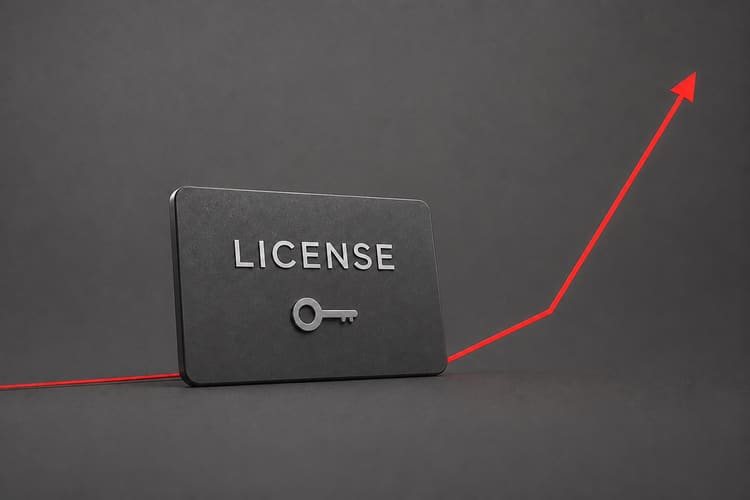
If an appliance contains more RAM and flash and those components become more expensive, a higher hardware price is logical. It is less logical that a firewall subscription linked to the hardware also carries part of the increase at the next affected purchase. Sophos distributes the increase across hardware and the associated license to preserve the existing cost ratio in the bundle.
This is where a technical explanation turns into a commercial decision. The price ratio between metal, memory and software is not a law of nature. Sophos set it and could also change it. Higher memory costs explain the price of the appliance. They do not automatically explain higher costs for IPS signatures, Web Protection, support or the right to keep using protection features on hardware that is already installed.
For new customers, Sophos can still argue that it calculates a complete package. With a new term for an existing installation, however, the appliance has long been in the rack and has already been paid for. If the linked subscription still becomes more expensive through the new price list, the existing customer is not financing new memory. They are paying because Sophos wants to preserve the ratio in its own pricing model.
That smells like greedflation, even if it does not yet prove it.
And what about the layoffs?
In February 2025, shortly after completing the 859 million dollar acquisition of Secureworks, Sophos confirmed that it would cut around 6 percent of the combined workforce. The affected roles included software development, threat research, program management and marketing. Sophos attributed the move to duplicate positions following the acquisition and roles no longer required after Secureworks was taken private.
The chronology must remain clear. The confirmed round of layoffs did not happen at the same time as the July 2026 price increase, but about a year and a half earlier. It also followed an acquisition in which overlapping roles are realistic. Anyone claiming that Sophos dismissed employees in order to increase firewall margins in 2026 is inventing a connection that the available sources do not support.
Even so, both events shape the same customer perception. Sophos is owned by private equity firm Thoma Bravo, acquired Secureworks, cut jobs shortly afterward and in 2026 publicly speaks of greater efficiency through company-wide use of AI. At the same time, prices for XGS hardware and linked subscriptions are rising. From the company’s perspective, these are separate decisions. For an existing customer, the message is simpler: fewer people, greater efficiency, higher bill.
The layoffs therefore do not prove greedflation. But they make it harder for Sophos to explain a price increase on software components convincingly through more expensive hardware alone.
Why customers are switching to OPNsense and UniFi
I now see more and more customers evaluating alternatives for precisely this reason. After three or four years, the next licensing round in my quotes and customer discussions is often at least 7 percent more expensive, and sometimes considerably more. This is not a general market statistic, but my practical observation from recurring firewall projects.
Some of these customers switch to OPNsense. The platform is open source and can be operated without a conventional firewall subscription. Professional support, the Business Edition and additional commercial rulesets can still cost money, but basic operation does not depend on an annually renewed security license.
Other customers move to UniFi. Ubiquiti now explicitly advertises “No licenses. No subscriptions.” For many small and medium-sized environments, this predictability is more attractive than the next renewal round from a conventional security vendor.
Both approaches have limits. A UniFi Cloud Gateway does not automatically replace every Sophos feature, and OPNsense without suitable add-on services, expertise and operational processes does not provide the same protection scope or vendor support. Nevertheless, the decision is shifting. Customers no longer compare only IPS throughput and feature lists. They increasingly ask whether the additional protection still justifies permanently rising license costs.
My conclusion
Greedflation is not a magic word that automatically makes every unpopular price increase immoral. Companies are allowed to make profits. They can pass on higher costs and charge for new features. Without profit, there is neither product development nor reliable support.
Sophos is neither the only nor automatically the worst vendor in this respect. Microsoft, Google, Adobe, Spotify and VMware demonstrate the same basic trend in different forms: more bundles, more subscriptions and regular increases justified by additional features or higher operating costs.
Sophos’s 2026 increase for XGS hardware is understandable in principle. Memory prices have genuinely risen, and software-only products are exempt from this round. That weighs against the simplistic claim that Sophos merely used some crisis as a pretext.
The increase on linked firewall subscriptions, especially for new terms on existing installations, remains difficult for me to accept. An appliance that is already installed does not acquire retrospective manufacturing costs because NAND flash has become more expensive. If its license is nevertheless included in the increase through the updated price list, that is not a technical necessity but a decision about margins and pricing structure.
Together with the earlier layoffs and today’s promise of efficiency, this sounds like greedflation. The public figures do not prove it. But Sophos is responsible for dispelling the suspicion through transparency. Customers should not have to explain why they question an increase. The vendor should explain why 10 percent on hardware and software is really supposed to be the same answer.
Until next time,
Joe
Sources
- IMF: Import prices, profits and wages as drivers of euro area inflation
- Microsoft: Copilot, Classic plans and higher Microsoft 365 prices
- Google: Gemini is integrated into Workspace and prices are adjusted
- Adobe: Creative Cloud Pro, new AI features and new prices
- Spotify: Higher prices as a growth lever with low cancellation rates
- VMware by Broadcom: End of perpetual licenses and move to subscriptions
- Sophos: Confirmation of the XGS price increase from July 1, 2026
- CRN: Sophos confirms cuts affecting around 6 percent of jobs
- Sophos: Organizational restructuring and company-wide AI efficiency in 2026
- OPNsense: Open-source platform and feature overview
- Ubiquiti: UniFi without licenses and subscriptions