Sophos vs SonicWall: The 2026 Comparison
Network Sophos SecurityTable of Contents
When someone searches for Sophos vs SonicWall, they are usually not looking for an academic feature matrix. There is normally a real buying decision behind it: Which firewall should go into headquarters, which one into the branches, which platform can my team operate cleanly, and which product will not create more work in two years than it promises to save today?
That is why this comparison is harder than vendor battlecards make it look. Sophos and SonicWall serve a similar market, but they come from different product philosophies. Both are strong in SMB and mid-market environments. Both often land with admins who have to run many things at once: site-to-site VPN, web protection, IPS, TLS inspection, SD-WAN, centralized management, and reporting. Yet the two platforms feel very different in daily operations.
I am writing this deliberately from my own point of view. I have worked with many firewalls, and I do not see myself as religiously attached to one vendor. Right now I am still more in the Sophos camp, because I like how Sophos Firewall structures many day-to-day tasks: rules are readable, Sophos Central is useful for many teams, web protection and WAF are usable on the box, and with SFOS v22 the platform has clearly moved toward secure-by-design.
But I am not blind to what annoys me about Sophos. Development around everyday administration is too slow. Many things Security Engineers have needed for years belong directly in the firewall or in Sophos Central: bulk editing, NAT cloning, object cleanup, shadow rule detection, good diffs, better change history. Instead, more and more of these workflows are moving into an external browser tool such as Sophos Firewall Config Studio. The tool itself is good. Needing it for core work is questionable.
With SonicWall, the pain is different. SonicWall has real technical substance with RFDPI, RTDMI, Capture ATP, NSM, and Cloud Secure Edge. At the same time, SonicWall was under significant trust pressure in 2024 and 2025 because of SSL VPN activity, CVE-2024-40766, and the MySonicWall cloud backup incident. Every vendor has CVEs. But with edge devices, the question is not only whether a patch exists. It is how the operational risk feels.
SonicWall impresses with familiar UTM logic; Sophos scores points where a small team wants to combine security and operations in one platform.
Short Verdict: Sophos or SonicWall?
If I had to condense the comparison strongly, I would put it like this:
Sophos Firewall is the easier recommendation for many classic SMB, mid-market, and Security Engineer teams in 2026 when usability, Sophos Central, web protection, integrated WAF, automatic hotfixes, Xstream Protection, NDR Essentials, and a readable policy model matter. Sophos is not perfect. The slow development of UI and Central still bothers me a lot. But the platform feels more coherent, simpler, and easier to integrate for many real environments.
SonicWall remains a serious option when many SonicWall firewalls are already deployed, when the admin team can operate NSM well, when Cloud Secure Edge is an interesting ZTNA/SSE direction, or when the organization deliberately values SonicWall security services, Capture ATP, and RTDMI. SonicWall is not simply “bad”. But anyone buying SonicWall in 2026 has to put the patch, SSL VPN, and cloud-backup context honestly into the risk assessment.
My personal tendency: If I had to choose today for a typical company with a few sites, a classic internet edge, remote access, web protection, some DNAT/WAF scenarios, and a small security team, I would lean toward Sophos. Not because Sophos is untouchable, but because the combination of usability, Central integration, hotfix model, and security architecture makes more sense for that use case.
If an organization is already deeply invested in SonicWall, the internal team knows SonicOS well, Cloud Secure Edge is part of the strategy, and PSIRT discipline is strong, SonicWall can still make sense. But not as “set and forget”. It needs proper hardening, MFA, credential rotation, restricted management access, and a very awake view of SSL VPN.
How I Evaluate This Comparison
A fair Sophos Firewall vs SonicWall comparison cannot stop at feature checkboxes. That is the weakness of many battlecards. The Sophos battlecard I was given as context is a good example: it lists many points where Sophos looks better. That is expected from a sales document. Sophos itself notes in the document that it is its own interpretation of public data and should not be used as the basis for buying decisions. That is exactly how I read it: as a list of hypotheses, not as neutral truth.
So I look at different questions:
- How quickly can an engineer change a rule without missing side effects?
- How well can I identify NAT, VPN, web protection, and TLS inspection problems?
- How mature is the patch process for edge risk?
- How well does central management work in real multi-firewall environments?
- How much can I see in logs before I need Syslog or a SIEM path?
- How cleanly can API and automation workflows be built?
- How realistic are HA, firmware upgrades, and maintenance windows?
- How well does the licensing model fit the admin team’s operating model?
- How does the platform feel after three years of rule growth?
Feature lists are not useless. But they often lie by omission. A firewall can do many things in theory and still be painful in production. Another product can look less spectacular and still be the better tool for the team.
Quick Comparison
| Area | Sophos Firewall | SonicWall | My take |
|---|---|---|---|
| Security architecture | Xstream, FastPath, hardened kernel, modular control plane, XDR Linux Sensor in SFOS v22 | RFDPI, Capture ATP, RTDMI, SonicOS 7/8, strong gateway malware detection | Sophos feels more modern in platform hardening; SonicWall remains strong in sandboxing and memory inspection. |
| Rules and NAT | Readable, zone-based, separate NAT rules, but weak bulk workflows | Traditional network style, granular, more modern in SonicOS | Sophos is easier to understand for many teams; SonicWall fits classic firewall admins better. |
| VPN / ZTNA | Sophos Connect, IPsec, SSL VPN, ZTNA through Central and firewall gateway | IPsec, SSL VPN/NetExtender, Cloud Secure Edge as ZTNA/SSE path | SonicWall carries the heavier SSL VPN risk context, but CSE is strategically interesting. |
| SD-WAN | Solid for SMB, SD-RED is strong for simple branches, Central Orchestration | SonicOS SD-WAN, NSM orchestration, CSE integration | Both are enough for many sites. Neither is automatically an enterprise SD-WAN king in this class. |
| Web / App Control | Web policies, DNS Protection, Synchronized App Control with Sophos Endpoint | Content Filtering, App Control, DNS Security depending on suite | Sophos is nicer when endpoint and firewall cooperate. SonicWall is classically solid. |
| IPS / TLS Inspection | Xstream TLS/DPI Engine, FastPath offload on XGS, TLS 1.3 | RFDPI, DPI-SSL, Capture ATP, RTDMI | Sizing must be tested with real policies. Datasheet values alone are not enough. |
| WAF | Integrated Web Server Protection with reverse proxy, templates, and clear limits | No equivalent on-box reverse-proxy WAF as a core firewall function | Sophos has a real advantage for simple publishing scenarios. |
| Email Security | MTA mode, SPX, firewall module plus Sophos Email in Central | Separate hosted or on-prem email security | I would not base an email-security decision on the firewall in 2026. |
| Central Management | Sophos Central, simple, but limited for serious policy governance | NSM cloud/on-prem, templates, reporting, fleet management | SonicWall NSM is strong for fleets; Sophos Central is easier for small teams. |
| Logging / Reporting | On-box reports, Central Reporting 7/30/365 days depending on license | NSM Reporting/Analytics, CTA reports, retention depending on suite/tier | Sophos is quick in daily troubleshooting; SonicWall is stronger for centralized fleet reporting. |
| API / Automation | XML API, SDK, Config Studio can generate API and curl output | SonicOS REST/API, NSM workflows, bearer-token improvement in 7.3.2 | SonicWall looks more modern in API form; Sophos remains practical but XML-heavy. |
| Roadmap | Strong hardening, NDR, Active Threat Response, but slow admin ergonomics | CSE, NSM, SonicOS 8, but high patch and trust pressure | Sophos must move faster on UI/Central. SonicWall needs a calmer security cycle. |
Security architecture and firewall rules
Security Architecture: Xstream versus RFDPI and RTDMI
Sophos and SonicWall both sell next-generation firewalls, but the architecture story is different.
Sophos positions the XGS series around Xstream Architecture, FastPath, and the Xstream Flow Processor. In simple terms, not every packet of every flow should run through the full inspection path again and again. After initial evaluation, trusted traffic can move into FastPath. On XGS hardware this is backed by a dedicated network processing unit; in virtual or software deployments, that specific hardware advantage is missing. That matters if you evaluate Sophos not only as an appliance, but also as a cloud or virtual firewall.
With SFOS v22, Sophos went beyond performance. The release notes mention a hardened Linux 6.6+ kernel, process isolation, containerization of services such as IPS, a new control plane, Firewall Health Check against best practices and CIS benchmarks, Remote Integrity Monitoring, and integration of the Sophos XDR Linux Sensor. Those are not just marketing details to me. Edge devices are targets. A firewall must not only filter traffic; it must also be harder to compromise itself.
SonicWall comes from another angle. SonicWall’s deep packet inspection approach is RFDPI, or Reassembly-Free Deep Packet Inspection. The idea is to inspect traffic in the stream without having to buffer entire files in the classic way. Capture ATP and RTDMI, Real-Time Deep Memory Inspection, add cloud sandboxing and memory-based detection for unknown or evasive malware.
That is not empty technology. SonicWall has real strengths around gateway malware detection and sandboxing. Calling it merely an “old SMB firewall” would be too shallow.
Still, Sophos feels fresher to me in 2026 when it comes to hardening the firewall platform itself. SFOS v22 visibly asks: what happens if the firewall is attacked? SonicWall has strong inspection technology, but the last few years show that edge security is also about management, cloud backups, VPN access, credential hygiene, and firmware processes.
Security Advisories and Trust
With firewalls, security incidents must be discussed early. Not to bash a vendor, but because these devices sit at the edge of the network. A firewall vulnerability is rarely an ordinary software issue. It can be an entry point into the whole organization.
SonicWall had a highly relevant case with CVE-2024-40766. NVD and CISA list it as a critical SonicOS Improper Access Control Vulnerability. CISA added it to the Known Exploited Vulnerabilities Catalog on September 9, 2024 and marks it as used in ransomware campaigns. SonicWall later wrote in an advisory for Gen 7 and newer firewalls with SSL VPN that the observed activity was not assessed as a new zero-day, but strongly correlated with CVE-2024-40766. Many cases involved migrations from Gen 6 to Gen 7 where local passwords were not rotated.
The lesson for engineers is important: even if firmware is patched, old credential state can carry risk forward. Firewall migrations need deliberate handling of local users, LDAP mappings, MFA seeds, VPN groups, shared secrets, admin accounts, and cloud backups.
The second major SonicWall trust point is the MySonicWall Cloud Backup File Incident. SonicWall confirmed after the Mandiant investigation that an unauthorized party accessed firewall configuration backups for all customers who had used the cloud backup service. SonicWall stresses that credentials in those files were encrypted. But firewall backups still contain topology, services, accounts, VPN structures, and other information that can help follow-on attacks. CISA advised customers to follow SonicWall’s advisory and remediation steps.
Sophos also has no clean slate. The Pacific Rim report from Sophos X-Ops describes years of attacks against Sophos firewalls by China-based actors. At the end of 2024 there were also critical Sophos Firewall advisories for CVE-2024-12727, CVE-2024-12728, and CVE-2024-12729. Sophos states that for customers on remediated versions with automatic hotfix installation enabled, no action was required because hotfixes were applied automatically. Operationally, that automatic hotfix pipeline is a real advantage, even if it does not replace firmware upgrades and hardening.
My conclusion here: Sophos currently feels more transparent and operationally more comfortable around hotfixing. SonicWall is under stronger trust pressure in 2026 because SSL VPN activity, credential rotation, and cloud-backup risk come together. That does not make SonicWall unusable. It means operating SonicWall in 2026 requires more discipline.
Firewall Rules and NAT
Firewall rules are daily life. Not the architecture slide decides the outcome, but the question: can I change, understand, and later find a rule?
Sophos is more pleasant for many teams. The rule structure is readable: source, destination, service, user, zone, web policy, IPS policy, app control, logging. NAT has been cleanly separated since SFOS v18. That makes many rules easier to understand because DNAT, SNAT, and firewall permission do not disappear into one unreadable construct.
In smaller and midsize environments, that is a real advantage. When a colleague opens a rule, they can usually see fairly quickly what it is supposed to do. Teams that do not build firewalls every single day benefit from that.
SonicWall feels more traditional. Access rules, NAT policies, address objects, service objects, zones, and policies are technically clear, but more rooted in classic firewall thinking. If you come from the SonicWall world, you will find your way. If you are new, it takes more adjustment, especially in grown environments.
Sophos also has my biggest criticism here. In larger rule bases, the Sophos GUI is not good enough. Bulk changes are too weak. NAT rules are not as efficient to clone, group, and analyze as I expect in 2026. Objects, unused references, duplicates, rule conflicts, and before/after diffs should live directly in WebAdmin or Sophos Central.
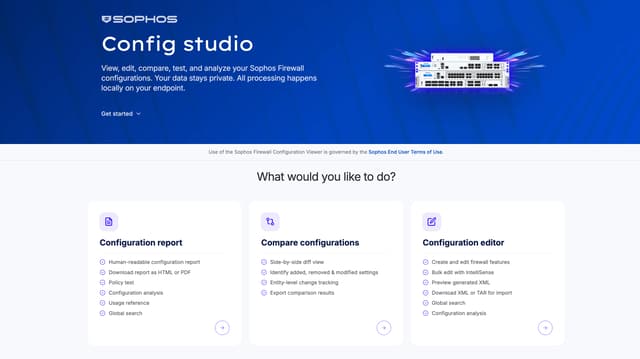
Config Studio V2 helps. You can view, compare, edit configurations, and export them as API or curl output. That is useful. But it is not a substitute for native product maturity. Exporting a firewall, loading an Entities.xml into a browser tool, and using basic quality-of-life functions there is not an ideal admin workflow. It can be great for audits and migrations. For daily configuration, it belongs closer to the platform.
SonicWall is not automatically better on this point. SonicWall configurations can also sink into object sprawl, old NAT policies, and historically grown rules. But SonicWall NSM is moving more strongly toward central visibility, configuration audit, and fleet management. Sophos Central is simpler, but for real policy governance it is not where I want it to be yet.
Connectivity and site networking
VPN, ZTNA, and Remote Access
Remote access is one of the most important differences in 2026. Not because one vendor can do VPN and the other cannot. Both can. The risk context is different.
Sophos offers Sophos Connect, IPsec, SSL VPN, and ZTNA through Sophos Central. SFOS v22 MR1 added Sophos Connect 2.0 for macOS with SSL VPN support. At the same time, Sophos removed legacy remote access IPsec. That is painful for old environments, but understandable from a security and product-maintenance perspective.
Sophos ZTNA fits well when Sophos Central, Sophos Endpoint, and Sophos Firewall are already in use. You can publish internal web apps and services more granularly instead of giving every user a full tunnel into the network. For many mid-market environments, this is a pragmatic path that does not require a huge SASE project immediately.
SonicWall has historically strong IPsec and SSL VPN functions, but the SSL VPN stack has become a sensitive topic after recent years. CVE-2024-40766, SonicWall advisories, and later SSL VPN activity around migrated accounts show that remote access can no longer be treated as a convenient add-on. SonicWall even has a current knowledge-base article describing how to disable SSL VPN. That alone is not a judgment, but it shows how seriously the operating mode must be treated.
On the other side, SonicWall Cloud Secure Edge is interesting. CSE came into the portfolio through the Banyan Security line and is integrated as a connector in SonicOS 7.1.2 and later. The connector creates an outbound tunnel to the Global Edge Network infrastructure without needing inbound ports for the connector. Access control lives in the CSE cloud. That is conceptually more modern than classic SSL VPN and interesting for SSE or Zero Trust architectures.
My take: If you use Sophos Central and Sophos Endpoint, Sophos ZTNA gives you a natural path. If you want to use SonicWall Cloud Secure Edge strategically, test CSE seriously on its own and do not treat it only as a “VPN replacement on the firewall”. I would run classic SonicWall SSL VPN in 2026 only with very strict hardening, MFA, credential rotation, restricted sources, and current firmware.
SD-WAN and Site Connectivity
SD-WAN is solid on both sides, but neither product should be bought blindly only because of SD-WAN.
Sophos offers SD-WAN routes, gateway monitoring, performance-based selection, VPN orchestration through Central, and SD-RED for simple branches. SD-RED is a practical advantage. Small branches, retail sites, or technical locations can be connected without needing a firewall engineer on-site.
SonicWall also has integrated SD-WAN in SonicOS, orchestration through NSM, and in the Cloud Secure Edge context a modern ZTNA/SSE path. For classic hub-and-spoke designs, that is enough in many cases.
The difference is more about operating philosophy. Sophos is nice when SD-WAN should be part of a readable firewall configuration. SonicWall is attractive when NSM, central templates, and reporting are important. For very large enterprise SD-WAN designs, I would honestly evaluate additional vendors as well.
Protective services and inspection
Web Protection and Application Control
Web protection is an area where Sophos is strong in everyday use. Categories, policies, exceptions, user context, application control, reporting, and DNS Protection are relatively understandable. With Sophos Endpoint, Synchronized App Control adds more context: the firewall can better identify which process generated traffic, even if the application lacks a clean signature or only speaks generic HTTPS.
That is valuable in real networks. Many modern apps look boring on the wire: HTTPS to somewhere. If the endpoint can say which process is behind it, the firewall decision becomes better.
SonicWall has Content Filtering Service, Application Control, DNS Security depending on suite, and Capture Labs signatures. That is proven and sufficient for many environments. SonicWall is not weak here. But Sophos’ combination of firewall, endpoint, Security Heartbeat, and Synchronized App Control is the more interesting operating model when Sophos Endpoint is present.
Without Sophos Endpoint, that advantage becomes smaller. Sophos remains usable, but the special context is gone. That pattern repeats: Sophos is strongest when multiple Sophos products are used together. That can be value, but it can also be lock-in.
IPS and TLS Inspection
I would never buy IPS and TLS inspection only by datasheet. Both vendors can do TLS 1.3, DPI, and IPS. Both can show impressive numbers. Both can collapse in practice if undersized or configured with unrealistic policies.
Sophos uses the Xstream TLS and DPI Engine, FastPath, and on XGS hardware the Xstream Flow Processor. The idea is sound: trusted traffic should reduce CPU pressure so heavier inspections have more room. But it only works as far as the real environment matches that architecture. Virtual deployments do not have a physical Xstream Flow Processor. And TLS inspection is always more than turning on a switch.
SonicWall relies on RFDPI and DPI-SSL. The argument is efficient stream inspection plus Capture ATP and RTDMI for file and unknown malware depth. That is plausible and should not be minimized.
For real projects, these questions matter to me:
- How much of the traffic is actually decrypted?
- How are certificates distributed?
- Which SaaS, banking, health, and business applications need exceptions?
- What happens with QUIC and HTTP/3?
- Which IPS policies actually run in production?
- How does the appliance behave under video conferences, updates, and large downloads?
- How good is troubleshooting in the Log Viewer and Packet Capture?
My advice: pilot both products with a real policy set. Do not compare firewall throughput. Compare throughput with the protection features you will actually enable.
WAF and Reverse Proxy
Sophos has a clear practical advantage here. Sophos Web Server Protection is an integrated reverse-proxy WAF on the firewall. It can publish internal web servers, use HTTPS/SNI, apply WAF rules, and work with features such as URL hardening, form hardening, and cookie signing. For classic internal portals or simple publishing scenarios, that is very convenient.
But it is not an enterprise WAAP platform. Sophos documents clear limits: a maximum of 60 WAF rules, IPv4 focus in the WAF rule logic, no WebDAV support, and no template support for Exchange versions newer than 2013. For Nextcloud, modern APIs, bot management, WebSocket-heavy applications, or critical web platforms, I would evaluate a dedicated WAF/WAAP solution.
SonicWall does not have an equivalent on-box reverse-proxy WAF as a core firewall feature. It can control web traffic and apply security services, but that is not the same as Sophos Web Server Protection for hosted web services.
If the requirement is to publish a couple of internal web apps behind the firewall, Sophos is often nicer. If the requirement is strategic application security, both firewalls are only part of the discussion.
Email Security
Email security is always tricky in firewall comparisons. Historically, UTM products tried to do everything on the box: web, mail, VPN, WAF, IPS. In 2026, email is its own security domain.
Sophos Firewall has Email Protection with MTA mode, transparent mode, SPX encryption, and per-domain routing. Still, I would clearly not recommend the Sophos Firewall email module today. It may still work for very small legacy environments, but strategically it is not a good reason to buy the firewall. The module feels old, innovation is visibly elsewhere, and Sophos is pushing modern email security toward Sophos Email and Sophos Email Plus in Central. I wrote about that separately in Sophos Email Plus: value or upsell?.
SonicWall separates email security more clearly with hosted or on-prem email security products. That is architecturally cleaner, but it is still another product, another license, and another operational surface.
My opinion: I would not buy a firewall today because it “also does email”. In Microsoft 365 environments, email security has to compete with Defender for Office 365, Proofpoint, Mimecast, Sophos Email, Abnormal, IRONSCALES, and other modern approaches. The firewall can help, but it should not be the center of the email-security strategy.
Management and automation
Central Management
Sophos Central is a strong argument for many teams. Registering firewalls, seeing firmware, backups, reporting, alerts, Central Firewall Management, SD-WAN/VPN orchestration, and jumping into WebAdmin is straightforward. If Sophos Endpoint, MDR, XDR, Email, switches, or APs are already in Central, you get one platform.
But Sophos Central is not as strong for firewall configuration management as it should be. It is good for visibility, simple management, and some standardization. It is less good for complex multi-firewall policy governance, clean diffs, robust change reviews, global object cleanup, and large rule bases. That is exactly why Config Studio bothers me: it shows that Sophos knows what admins need, but builds it next to the platform instead of deep inside it.
SonicWall NSM is more focused on firewall fleet management. SonicWall describes it as a central platform for visibility, risk, compliance, hierarchies, zero-touch deployment, templates, configuration audit, advanced search, and reporting. For admin teams with many sites, that is attractive because central management is more than a list of links to individual firewalls.
The decision depends heavily on the team. Small internal IT teams will often become productive faster with Sophos Central. Larger internal teams with many sites and strong operational discipline can benefit from NSM.
Logging and Reporting
Logging decides whether you investigate or guess during an incident.
Sophos has on-box logging and reporting that is very helpful in daily work. Web reports, user activity, applications, firewall rules, VPN, IPS, and system logs are quickly available. For many questions, you do not immediately need an external SIEM.
Sophos Central adds firewall reporting with different retention tiers: typically seven days without a reporting license, up to 30 days with Xstream, and up to 365 days with Central Firewall Reporting Advanced, depending on storage and log volume. That is useful, but long retention is not simply free.
SonicWall has NSM Reporting/Analytics, Capture Threat Assessment reports, and retention depending on suite. For admins, the key question is whether analysis is fast enough during an incident and whether retention fits compliance and forensic needs.
My impression: Sophos is quicker for day-to-day troubleshooting. SonicWall is stronger when reporting is seen as centralized fleet analysis. For serious security operations, both belong into a SIEM or data-lake model as environments grow.
API and Automation
Both platforms are imperfect for automation, but in different ways.
Sophos historically has an XML API. It works and is useful in many projects, but it does not feel as modern as I would like in 2026. There is a Sophos Firewall SDK, and many admins build scripts for objects, hosts, services, backups, or reports. SFOS v22 improved API access controls with allowed-source IP host objects. Config Studio V2 can export API or curl output, which helps with bulk changes and migrations.
SonicWall SonicOS offers a REST/API interface. According to the SonicOS API documentation, the API is disabled by default and must be enabled deliberately. SonicOS 7.3.2 introduced bearer-token validation for non-GUI/API sessions. That is a sensible security improvement, even if the option is off by default.
From an engineering point of view, SonicWall’s API form is more modern. Sophos is often practical, but historically XML-heavy. If someone expects real Infrastructure as Code for firewall policies, I would evaluate both vendors critically.
Operations, costs and life cycle
Performance and Sizing
I deliberately avoid a synthetic throughput table. Not because performance is irrelevant, but because such tables are often more theater than engineering.
Both Sophos and SonicWall can show impressive numbers. What matters is not maximum firewall throughput without real security load. What matters is the traffic mix with IPS, web protection, TLS inspection, app control, sandboxing, logging, VPN, SD-WAN, and real users.
Sophos XGS has the Xstream Flow Processor advantage on hardware. That can help with trusted flows, VPN, and SaaS traffic. In virtual environments, the concrete NPU offload advantage is not there.
SonicWall has a strong streaming inspection story with RFDPI and multi-core architecture. But smaller TZ models and entry-level hardware must be sized carefully, just like Sophos. Once DPI-SSL, IPS, and app control are truly active, the datasheet value is only a rough hint.
My practical rule: do not buy by “firewall throughput”. Buy by protected throughput and a real pilot. If a customer has 1 Gbit/s internet and wants to inspect everything, datasheet optimism is not enough.
HA and Stability
HA is where marketing becomes quiet quickly. In diagrams, an active-passive cluster always looks clean. In practice, what matters is what happens during upgrades, link failure, VPN, proxy traffic, WAF, log databases, and partial failure.
Sophos HA is attractive for many SMB environments, including the licensing logic. Sophos documentation is honest about limits: session failover does not apply to every traffic type. VPN traffic, UDP, ICMP, proxy subsystems, and AV-scanned sessions have their own behavior.
In my experience, Sophos has been generally operable since v18, but the last releases have cost some trust again. There were real bugs around HA, logging, interfaces, VPN, and UI behavior. I wrote about that in Sophos Firewall: no CVEs, but bugs.
SonicWall HA is not a toy either. Depending on model and license, there is stateful HA and other variants. NSM can improve fleet operations. But SonicWall environments need careful planning around firmware paths and upgrade dependencies.
My recommendation for both: do not test HA for the first time during an incident. Firmware upgrade in the cluster, failover, VPN reconnect, WAF publishing, SSL/TLS inspection, routing, and monitoring belong in a real maintenance window with a rollback plan.
Licensing and TCO
Sophos is commercially easier to explain. The Xstream Protection Bundle includes core firewall functions, Network Protection, Web Protection, Zero-Day Protection, Central Orchestration, DNS Protection, and bundle-only features such as Active Threat Response and NDR Essentials. Email Protection and Web Server Protection can be added separately. For many customers, Xstream is the package they will usually want.
What bothers me with Sophos is less the structure and more the promotion and discount culture. There are often campaigns, discounts, bundles, and time-limited incentives. That can be good financially, but it can feel noisy. Technically, Xstream Protection remains a strong package.
SonicWall works more with tiered security suites. APSS includes services such as IPS, app control, content filtering, gateway anti-virus, DNS Security, Deep Packet TLS/SSL Inspection, Capture ATP, NSM Cloud Management, and reporting tiers. That can make sense, but it makes the comparison less direct because you must check exactly which services, retention levels, and management functions are included in the actual quote.
In short: Sophos is easier to buy and explain. SonicWall is more tiered. The final TCO for both depends on real quotes, reporting retention, ZTNA, email, WAF, and operational effort.
Daily Usability
Sophos wins the first impression for me. The firewall is usually faster to understand. Rules read better. Many features are where an admin expects them: web protection, WAF, VPN, NAT, and reporting.
But Sophos loses points once the rule base grows or many changes are needed. Then you notice that WebAdmin and Central still lack modern admin ergonomics. Search, bulk edit, diffs, object maintenance, NAT workflows, and change history need to improve. Config Studio is a good side entrance, but not a replacement for native UX.
SonicWall feels more classic and more technical. If you know SonicOS, you can work quickly. The UI has become more modern, NSM gives more central visibility, and SonicWall offers more tools for fleet management. But the platform is not as light as Sophos Central. You feel more context switching between portals and products.
My personal view: Sophos is nicer for a small team that wants to operate a firewall well. SonicWall is nice for teams that already know SonicWall and need central fleet processes. I would get newcomers productive faster on Sophos.
Development Speed and Roadmap
This is where my Sophos conclusion becomes critical.
Sophos is moving in the right strategic direction: SFOS v22 with secure-by-design, Firewall Health Check, XDR Linux Sensor, NDR Essentials, Active Threat Response, better audit logs, sFlow, and Config Studio V2. These are real things. I do not want to minimize them.
But development of everyday admin experience is too slow. For years, large rule bases have needed bulk editing, NAT cloning, object deduplication, unused object detection, shadow rules, good diffs, better change history, and real Central policy governance. If these functions grow outside the firewall in Config Studio, it feels like a bypass road around the actual product.
SonicWall is developing differently. Cloud Secure Edge is strategically interesting, NSM is becoming more visible, SonicOS 7.3.2 brings API-security improvements, and SonicOS 8 moves the platform forward. But SonicWall must regain trust. After CVE-2024-40766, SSL VPN activity, and the MySonicWall cloud backup incident, “we have features” is not enough. The next 18 months need to be calmer.
My roadmap expectation:
- Sophos must deliver native admin ergonomics in WebAdmin and Central.
- SonicWall must show that edge risks, cloud backups, and SSL VPN operations are sustainably under control.
- Both must take API, automation, and change governance more seriously.
When I Would Choose Sophos
I would choose Sophos when:
- a small or mid-sized security/IT team has to operate the firewall,
- Sophos Central is already strategically set,
- Sophos Endpoint, MDR, or XDR are in use,
- web protection, WAF, and reporting need to be usable quickly,
- SD-RED or simple branch connectivity matters,
- automatic hotfixes and secure-by-design hardening are weighted highly,
- the environment is more mid-market than enterprise firewall governance,
- operations must be more pragmatic than the platform slide.
But I would buy Sophos with a clear expectation: the firewall is strong, but not perfect. Anyone with many large rule bases, many firewalls, and strict change governance should test Sophos Central critically.
When I Would Choose SonicWall
I would choose SonicWall when:
- there is already a large SonicWall base,
- the admin team already knows SonicOS and NSM well,
- NSM and centralized firewall fleet management are important,
- Cloud Secure Edge is being seriously evaluated as ZTNA/SSE strategy,
- Capture ATP and RTDMI are heavily weighted as gateway malware protection,
- the team is ready to run PSIRT, firmware, and credential rotation consistently.
But I would not buy SonicWall in 2026 as “install and forget”. SSL VPN must be questioned critically. Cloud backups must be handled deliberately. Local accounts and MFA seeds must be rotated after migrations. Management access must be tightly restricted.
Is Sophos a SonicWall Alternative?
Yes, Sophos is a serious SonicWall alternative in 2026, especially for classic SMB and mid-market environments.
If someone wants to replace SonicWall because SSL VPN risk, cloud-backup trust, portal fragmentation, or old rule bases are annoying, Sophos Firewall is a very obvious candidate. Sophos is nicer in many day-to-day areas, has integrated WAF, strong web protection, Central integration, and a good Xstream Protection bundle.
If someone uses SonicWall because of NSM, CSE, or a large existing SonicWall fleet, the switch is less obvious. Sophos Central is simpler, but not automatically deeper. Anyone running SonicWall professionally through NSM should test Sophos with real multi-site workflows, not only on a demo firewall.
How I Would Test Both Firewalls
I would not test these systems with a sales demo scenario. I would test them with a bad Tuesday.
First test: build a real rule set. Client internet with web protection and TLS inspection, server-to-server with restricted services, DNAT for an internal web app, hairpin, site-to-site IPsec to another vendor, remote access, ZTNA to an internal app, a few user groups, and targeted exceptions. Then another engineer should understand the rule set in 30 minutes.
Second test: create failures. Wrong NAT, broken certificate in TLS inspection, IPS false positive, VPN phase-2 mismatch, blocked SaaS app, wrong route, WAF issue. Then measure how quickly the team reaches the cause with logs, packet capture, policy testing, and CLI.
Third test: HA and upgrade. Upgrade firmware in the cluster, trigger failover, observe VPNs, test WAF, run TLS inspection under load, check reporting. With Sophos I would look at SFOS v22 MR1 or newer. With SonicWall I would look closely at SonicOS 7.3.2 or SonicOS 8, NSM compatibility, NetExtender versions, and SSL VPN hardening.
Fourth test: operating cost. Sophos Xstream, Central Firewall Reporting Advanced, ZTNA, and Email. SonicWall APSS, NSM retention, CSE, and Email Security. Add the real work for both: patching, testing, documenting, troubleshooting, and log retention.
Conclusion: Sophos Is My Current Choice, but Not Without Criticism
If I must name a clear winner today, it is Sophos Firewall for most classic environments. Not because Sophos does everything better. Not because SonicWall is bad. But because Sophos gives many Security Engineers the more coherent operating model in 2026: readable rules, good web protection, integrated WAF, Sophos Central, automatic hotfixes, Xstream Protection, NDR Essentials, and a stronger secure-by-design story.
But Sophos must be careful. I am still in Team Sophos, but I am less patient than before. Slow admin-ergonomics development is a real problem. Config Studio V2 is a good tool, but it must not become an excuse to leave Firewall UI and Sophos Central slow. The best admin functions belong inside the product, not next to it.
SonicWall remains a valid platform, especially for existing SonicWall environments, CSE strategies, and teams that operate NSM properly. Technically, RFDPI, RTDMI, Capture ATP, NSM, and Cloud Secure Edge provide enough substance. But SonicWall must rebuild trust. SSL VPN activity, CVE-2024-40766, and the MySonicWall cloud backup incident are not background noise. They belong in every buying decision.
My recommendation is not “Sophos always, SonicWall never”. It is this:
If you are buying a new firewall for a classic SMB or mid-market setup without historical SonicWall baggage, test Sophos first. If you already operate SonicWall well, use NSM, and your processes are strong, SonicWall remains operable. But then operate it with adult hardening, not gut feeling.
This comparison is a snapshot. If Sophos visibly improves WebAdmin, Central, and config workflows in 2027, the recommendation becomes clearer. If SonicWall delivers a calm security cycle, stabilizes cloud-backup trust, and develops CSE cleanly, that must also change the evaluation.
Until next time,
Joe
FAQ
What is better: Sophos or SonicWall?
Is Sophos a good SonicWall alternative?
How critical is SonicWall SSL VPN in 2026?
Which Sophos Firewall experiences matter in 2026?
Who is better at ZTNA: Sophos or SonicWall?
Should I choose Sophos over SonicWall because of WAF?
Sources
- User-provided Sophos battlecard “SonicWall Firewall Battlecard”, updated March 2026
- Sophos Firewall v22 release notes
- Sophos: Faster, safer, stronger - Sophos Firewall v22 security enhancements
- Sophos Security Advisory: CVE-2024-12727, CVE-2024-12728, and CVE-2024-12729
- Sophos Pacific Rim report
- Sophos Firewall Xstream Protection Bundle
- Sophos Firewall Architecture and FastPath documentation
- Sophos Firewall WAF rules documentation
- Sophos Central Firewall Reporting storage
- Sophos Firewall HA operation
- Sophos Firewall ZTNA gateway integration
- SonicOS 7.3.2 release notes
- SonicOS/X API reference guide
- SonicWall Cloud Secure Edge Feature Guide
- SonicWall Network Security Manager
- SonicWall Firewall Security Services
- SonicWall Capture Advanced Threat Protection and RTDMI
- SonicWall RFDPI technical brief
- SonicWall: Gen 7 and newer firewalls SSLVPN recent threat activity
- SonicWall: MySonicWall Cloud Backup File Incident
- CISA KEV: CVE-2024-40766
- CISA Alert: SonicWall releases advisory after security incident