Sophos vs Fortinet 2026: Which Firewall Fits?
Network Sophos SecurityTable of Contents
When someone searches for Sophos vs Fortinet, it is rarely just about a neat comparison table. Most of the time there is a real buying decision behind it: Which firewall do I put into the Main Office, which one into the branches, which platform can my team operate cleanly, and which solution will not create more work in three years than it solves today?
That is exactly why this comparison is harder than many vendor slides suggest. Sophos Firewall and Fortinet FortiGate are not simply two boxes with the same features in different colors. The two products come from different ways of thinking. Fortinet has grown strongly out of networking, performance, ASICs, SD-WAN and Security Fabric. Sophos comes more from the security-admin side with Sophos Central, Security Heartbeat, understandable firewall rules and a firewall UI that many admins find approachable.
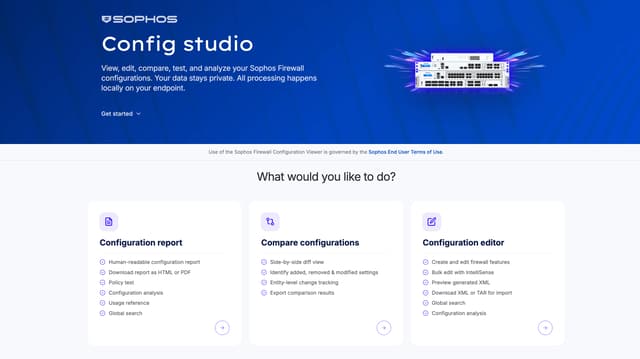
I have worked with many firewalls, and I would not describe myself as religiously attached to any vendor. At the moment I am personally still more in Team Sophos, because I generally like the way Sophos structures many things in daily operations. But honestly, I am starting to wonder for how much longer. I am getting increasingly annoyed by how long it takes Sophos to finally address certain things. That does not mean I blindly defend Sophos. Quite the opposite: especially with Sophos, I am bothered by how slowly some important topics move forward. When configuration analysis, and now even configuration changes, are moved into an external browser tool like Config Studio because the actual firewall UI or Sophos Central cannot deliver these functions cleanly, that is a very questionable development from an admin perspective. On top of that, the current Sophos Firewall bugs in v21.5 through v22 are slowly getting out of hand in operations and damaging exactly the trust a firewall platform should strengthen.
Fortinet offers tremendous depth; Sophos is often stronger when a smaller team needs to operate security reliably and clearly.
Short Verdict: Sophos or Fortinet?
If I had to compress it heavily, I would put it like this:
Fortinet is the stronger choice when performance, routing, SD-WAN, large distributed networks, CLI depth, FortiManager, FortiAnalyzer and a broad Security Fabric ecosystem are the main priorities. If you come from the network-engineering side, feel comfortable in the CLI and profiles, and want to standardize many sites, Fortinet has a lot of substance. Fortinet feels like it delivers more movement per quarter, but you also have to live with higher complexity and real patch pressure.
Sophos is the stronger choice when a smaller or mid-sized security team wants an understandable firewall, good central firewall management, simple operation, useful on-box functions and a more pragmatic operating logic. Especially in environments where Sophos Central already exists, the firewall can benefit from that. Still, I would buy it primarily as a firewall, not because of add-on products. Sophos feels more transparent and, with SFOS v22, more focused on hardening, but the product development often feels too slow in daily admin life.
In other words: for me, Sophos is often the better product for smaller and mid-sized teams. Fortinet is more often the stronger platform for larger realities. That is an important difference. A good product reduces friction in daily work. A strong platform gives you more depth, more building blocks and more scaling options. Depending on the team, both can be the right answer.
But Fortinet brings more CVE and patch pressure, at least if you look at recent years and current FortiOS advisories. Sophos currently brings more operations frustration for me through slow development, UI stagnation and firmware bugs. Both are real. So you are not choosing between “good” and “bad”, but between two different risk profiles.
My honest recommendation: For classic SMBs, Sophos Central, manageable networks and admin teams that do not want to live in the CLI every day, Sophos Firewall is often the more pleasant solution. For larger network landscapes, demanding SD-WAN, very high performance requirements and teams with a strong network-engineering focus, I would take Fortinet very seriously.
How I Evaluate This Comparison
A fair comparison between Sophos Firewall and Fortinet FortiGate must not stop at “has feature X”. In real environments, other questions matter:
- How quickly can an engineer build a rule change safely?
- How well can I detect side effects in NAT, VPN, Web Protection or TLS Inspection?
- How much can I see in the logs when something does not work?
- How expensive does the total package become with management, reporting, support, ZTNA, WAF and email security?
- How often do I have to patch at night?
- How reliably do HA, upgrades and remote-access clients run?
- How cleanly can the whole thing be automated?
- How well does the platform fit the team that has to run it?
That is why I do not structure this article as “feature list wins against feature list”. Feature lists are useful, but they lie by omission. A firewall can theoretically do everything and still be annoying in daily operations. Or it can look less spectacular and still be the better tool in production.
Quick Comparison
| Area | Sophos Firewall | Fortinet FortiGate | My Take |
|---|---|---|---|
| Architecture | x86 plus Xstream Flow Processor on XGS, FastPath for trusted flows | FortiASIC/SPU with network and content processors depending on model | Fortinet is usually stronger in raw throughput and offloading, while Sophos remains architecturally more flexible and easier to understand. |
| Firewall rules and NAT | clear zone logic, separate NAT, readable rules | flexible policy and Central NAT models | Sophos is more approachable, Fortinet scales better with complex rule sets. |
| VPN and remote access | Sophos Connect, IPsec, SSL VPN, ZTNA through Central | IPsec, ZTNA with FortiClient EMS, SSL-VPN tunnel mode is replaced from 7.6.3 onward | Fortinet forces migration more strongly, Sophos remains simpler for classic setups. |
| SD-WAN | solid for SMBs, branches and SD-RED scenarios | strong with ADVPN, application steering and large site networks | Fortinet clearly wins in enterprise SD-WAN. |
| Web Protection | understandable policies and exceptions | deep security profiles and FortiGuard services | Sophos is simpler, Fortinet is more granular. |
| WAF | integrated Web Server Protection with clear limits | FortiGate WAF is more basic, FortiWeb is the separate product | Sophos for simple publishing, a dedicated WAF for real AppSec. |
| Logging and reporting | on-box reporting and Central Firewall Reporting | FortiView locally, FortiAnalyzer for history and correlation | Sophos is faster to use, Fortinet is more mature in large environments. |
| API and automation | XML-based API, Config Studio as helper tool | REST API, FortiManager JSON-RPC, Terraform and Ansible | Fortinet is clearly stronger for NetOps and Infrastructure as Code. |
| HA and operations | attractive licensing logic, but real firmware and HA bugs need attention | mature HA options, but more complex and not bug-free either | Test both properly; be especially careful with Sophos because of current bugs. |
| Usability | understandable GUI, but often sluggish during larger changes | fast GUI and strong CLI, but steeper learning curve | Sophos forgives more, Fortinet rewards expertise. |
| Roadmap | more hardening and Secure by Design, slow admin ergonomics | high feature cadence, fast SD-WAN/SASE/AI development | Fortinet moves faster, Sophos has to catch up in firewall UX. |
Security architecture and firewall rules
Security Advisories and Patch Discipline
Before talking about UI, SD-WAN or licensing, you have to talk about patch discipline with firewalls. Both vendors build edge devices. Both are directly in attackers’ sights. And both have had vulnerabilities in recent years that should not be hand-waved away.
With Fortinet, the pressure is especially visible. The official FortiGuard advisories show several critical cases relevant to admins: CVE-2024-47575 in FortiManager allowed unauthenticated code execution according to Fortinet and was exploited in the wild. CVE-2024-55591 and CVE-2025-24472 affected FortiOS/FortiProxy and could give an attacker super-admin privileges. CVE-2025-59718 and CVE-2025-59719 affected FortiCloud SSO Login in several Fortinet products and were also marked as exploited.
That does not mean Fortinet is insecure. It means: if you run FortiGate or FortiManager, you need a very disciplined PSIRT process. Management interfaces do not belong openly on the Internet, FortiCloud SSO and admin access must be hardened deliberately, MFA is mandatory, and firmware versions must not sit untouched for months just because “everything is stable”.
Sophos also does not have a clean slate. The Sophos X-Ops Pacific Rim report is worth reading precisely because Sophos openly describes how China-based groups attacked perimeter devices, including Sophos Firewalls, over several years. In addition, there were critical Sophos Firewall advisories at the end of 2024 with CVE-2024-12727, CVE-2024-12728 and CVE-2024-12729. In such cases Sophos strongly points to automatic hotfixes, which are enabled by default. From my point of view that is a real advantage, but it does not replace a clean upgrade and hardening concept.
My take: Fortinet feels more like “fast, powerful, but you have to stay on top of it permanently”. Sophos has felt more focused on Secure by Design and transparency since v22, but is currently fighting more operational bug frustration. In both worlds the rule is: minimize WAN management, enforce MFA, turn off unnecessary portals, subscribe to advisories and do not treat patch windows as optional.
Security Architecture: Two Different Philosophies
With Fortinet, FortiOS is the center. FortiGate, FortiManager, FortiAnalyzer, FortiClient, FortiSwitch, FortiAP, FortiSASE, FortiWeb, FortiMail and many more products hang from the Security Fabric idea. Fortinet is therefore not just selling a firewall, but a very large platform in which networking and security are supposed to converge.
Technically, that is strong. Fortinet has invested very consistently in SD-WAN, SASE, ZTNA, ASIC acceleration, cloud firewalls and central management over recent years. The hardware approach is a real difference: depending on the model, Fortinet uses its own Security Processing Units, meaning Network Processors, Content Processors or Security Processors. That is why FortiGate looks so aggressive in many datasheets for IPsec, session handling, Threat Protection and SSL Inspection. With FortiOS 8.0, Fortinet positions the platform even more strongly toward AI control, SASE, post-quantum cryptography and simplified SD-WAN. Whether you need every marketing term in daily life is another question. But the direction is clear: Fortinet moves fast and very broadly.
Sophos takes a different approach. Sophos Firewall is strongly focused on an understandable admin experience, Sophos Central, Security Heartbeat, Web Protection, WAF, VPN, SD-WAN and increasingly integrated detection functions such as NDR Lite and Active Threat Response. Sophos sells less the image of an extremely deep network operating system and more a firewall that should be operable even without a pure network-specialist team.
The XGS hardware is not just a “normal x86 firewall” either. Sophos combines a multi-core CPU with the Xstream Flow Processor, an NPU for FastPath offloading. Trusted flows can be offloaded after the first inspection so CPU resources remain available for TLS Inspection, DPI, IPS and other heavy security tasks. That is not the same raw ASIC strategy as Fortinet, but it is clearly better than the old reputation Sophos still partly carries from earlier XG times.
From a security point of view, that is attractive. If the firewall gets more context about users, devices and health status, that is more valuable than an isolated block list. Sophos has had a good argument for years with Security Heartbeat and Synchronized Security, and it can genuinely help in operations. With SFOS v22, additional Secure by Design topics arrived, such as a hardened kernel, new control plane, Health Check, Remote Integrity Monitoring, NDR integration and Active Threat Response.
My problem is not the direction. My problem is the speed and execution. Sophos has good ideas, but it often takes a very long time until the admin ergonomics really catch up. Many quality-of-life topics that would make large installations much more pleasant have been open for years or now land in an external tool. Fortinet feels more restless, more complex, but also much faster by comparison.
Firewall Rules and NAT
With firewall rules and NAT, you notice the difference between the platforms very quickly.
Sophos is more understandable for many admins. The rule UI is visually clear, zones are prominent, user and app context are easy to reach, and many settings are where you expect them. Especially when a team is not deep in firewalls every day, that can be a real advantage. A Sophos rule often reads like an operational object: source, destination, service, user, web/IPS/app policies, logging. That is approachable.
Fortinet is more precise and deeper. If you know FortiGate well, you get a lot of control with policies, objects, Central NAT, policy NAT, VIPs, IP pools, proxy/flow mode, profiles and CLI. In large environments, that is an advantage because standards can be modeled more cleanly. At the same time, exactly this depth can overwhelm new teams. FortiGate is rarely “simple” if you want to operate it properly.
From my point of view Sophos has three weaknesses here. First, larger rule sets are not as pleasant to maintain in the GUI as they should be. Second, NAT rules are still an area where I would like to see better clone, bulk edit and analysis functions directly in the firewall. Third, the WebAdmin interface still feels more sluggish during many small changes than it should in 2026. Config Studio V2 helps with reading, comparing and now also editing configurations. But that is exactly the point: why do I need to leave the actual firewall for such workflows?
Fortinet has friction too. If you inherit poorly documented FortiGate rule sets, you can end up just as easily in object sprawl, historic VIPs, old IP pools and profile chaos. But Fortinet gives experienced engineers more tools to operate large rule sets professionally, especially together with FortiManager.
My take: Sophos wins on readability and entry. Fortinet wins on depth, scale and engineering control.
Connectivity and site networking
VPN, ZTNA and Remote Access
Remote access is one of the areas where both vendors are currently under pressure. Classic SSL VPN has become a security and operations topic for many vendors. At the same time everyone wants to move toward ZTNA, because user access should no longer just mean “tunnel into the network”.
Sophos offers Sophos Connect for both IPsec and SSL VPN. With SFOS v22 MR1, Sophos Connect 2.0 for macOS with SSL VPN support is an important step. At the same time, Sophos removed the old legacy remote-access IPsec option in v22 MR1. Technically that is understandable, but operationally it is a hard cut: firewalls with old legacy configuration cannot simply be upgraded to v22 MR1 and later.
Fortinet is moving away from classic SSL-VPN tunnel mode even more clearly. In FortiOS 7.6, SSL VPN was already removed on small 2 GB RAM models, and from FortiOS 7.6.3 onward SSL-VPN tunnel mode is replaced by IPsec VPN according to Fortinet. Existing SSL-VPN tunnel configurations are not simply carried over during upgrade. So anyone running FortiGate with remote access has to actively plan the IPsec or ZTNA migration and not discover during the maintenance window that the old architecture ends.
For new setups, I would clearly ask with Sophos: does the user really need full network access, or is ZTNA cleaner? Sophos ZTNA makes much more sense in Sophos Central than an old VPN mindset inside the firewall. If identity, device status and Central are already part of the operating model, Sophos is very attractive here.
Fortinet also has a strong ZTNA portfolio. FortiGate can combine ZTNA policy decisions with FortiClient EMS and security-posture information. Fortinet is broader here, but also more complex. In return, it fits well into larger environments where FortiClient EMS, FortiAuthenticator, FortiSASE or FortiManager are already part of the architecture.
For site-to-site VPN I traditionally see Fortinet as very strong. IPsec, routing, SD-WAN integration, ADVPN, hub-and-spoke, large branch landscapes and CLI debugging are Fortinet territory. Sophos can of course also do site-to-site IPsec, and for many environments that is fully sufficient. But as soon as it gets very large, very dynamic or heavily routing-based, Fortinet feels more mature.
Sophos counters with RED and SD-RED as a strong simplicity argument. For small branch offices that should be connected without a local network specialist, the concept remains charming. Fortinet can also handle branch offices very well, but the path there is more Fortinet-like: powerful, detailed, less “plug in and done”.
SD-WAN
If SD-WAN is the main topic, you have to take Fortinet seriously. Fortinet has invested a lot in Secure SD-WAN and is strongly perceived that way in the market. Performance SLA, link monitoring, application steering, overlay designs, ADVPN, central orchestration, FortiManager, FortiAnalyzer and SASE integration are a very rounded package if you plan it cleanly.
Sophos SD-WAN is more pragmatic. You get SD-WAN routes, gateway monitoring, profiles, VPN orchestration through Central and, with SD-RED, a simple branch option. For many SMB and midmarket environments that is enough. I know many networks where nobody needs a highly complex SD-WAN design. There it is more important that failover, priorities, VoIP, SaaS and a few branch tunnels work cleanly.
But Fortinet is ahead in breadth. If a customer plans many sites, multiple underlays, dynamic paths, application steering, central templates, differentiated reporting and long-term WAN modernization, I would not downplay Fortinet. Sophos can cover much of it, but Fortinet feels like a vendor that treats SD-WAN as a core competence. Sophos feels more like SD-WAN is an important part of the firewall, but not the center of the product identity.
And there is another practical point: Sophos had real fixes in v22 around policy-based IPsec, SD-WAN routing and VPN traffic. The fact that these fixes were needed is not a disqualifier, but it shows that Sophos upgrades in SD-WAN/VPN-heavy environments must be tested very carefully.
Protective services and inspection
Web Protection
Web Protection is an area where Sophos works pleasantly from my point of view. Categories, web policies, exceptions, TLS Inspection, malware scanning, user context and reporting are relatively understandable. For schools, SMBs and classic corporate networks, that can fit very well because many web policies remain comprehensible even without deep specialist knowledge.
Fortinet is also strong. FortiGuard Web Filtering, Application Control, Antivirus, DNS Filter, SSL Inspection, DLP and Security Profiles are very powerful. FortiGate allows very fine combinations and has enormous depth in experienced hands. In return, operation is less self-explanatory. You really need to understand profiles, inspection modes and policy inheritance.
So the difference is less “who can do Web Protection” and more “who can operate it cleanly in your team”. Sophos makes entry easier. Fortinet gives you more knobs.
For security engineers, another point matters: TLS Inspection is not just a feature, it is an operating model. Certificate deployment, exclusions, banking/health/privacy categories, QUIC, HTTP/3, performance, troubleshooting and privacy have to be clarified properly. I would never decide here only by datasheet. I would run a real pilot with the most important applications and measure what breaks in daily work.
IPS and TLS Inspection
With IPS and TLS Inspection, both vendors come with strong promises. Sophos talks about Xstream Architecture, Single Streaming DPI Engine, TLS 1.3 inspection and FastPath for trusted applications. Fortinet talks about FortiASIC, Security Processors, FortiGuard services and high performance through hardware offloading.
The decisive question is not which vendor has the prettier architecture slide. The decisive question is what load profiles you actually have:
- How much traffic is really decrypted?
- How many users hang off each appliance?
- Which applications run stably through TLS Inspection?
- How many IPS profiles are active?
- Which exceptions are needed?
- What happens with large downloads, SaaS, VoIP, video conferences and updates?
- How does HA behave under load?
Fortinet has a performance advantage in many scenarios, especially when suitable hardware with ASIC acceleration is used and the design matches it. Sophos XGS is also powerful, but with Sophos I would look more closely at how much TLS Inspection and IPS are really run at the same time. Not because Sophos fundamentally cannot do it, but because marketing numbers quickly become irrelevant once real policies, real users and real exceptions enter the picture.
My advice: do not buy either vendor’s appliance only by theoretical firewall throughput. The relevant throughput is the one with the protection features enabled that you actually need.
WAF and Reverse Proxy
WAF is a good example of how different expectations can be.
Sophos Web Server Protection is practical for many classic reverse-proxy scenarios. You can publish internal web servers, manage certificates, use Let’s Encrypt, set policies, Form Hardening, URL Hardening, Cookie Signing and now also consider MFA topics. For smaller and mid-sized environments, that is often exactly what is needed.
But it is not a full enterprise WAF in the sense of a specialized product with deep AppSec logic, bot management, API security, extensive positive security, learning mode and huge tuning workflows. Sophos also documents concrete limits: a maximum of 60 WAF rules, no WebDAV support and no support for Microsoft Exchange versions later than 2013 in the WAF templates. WebSocket passthrough is possible, but Sophos itself points out that no checks can be implemented there because of the protocol format. So if you want to protect Nextcloud, modern Exchange scenarios, APIs or WebSocket-heavy applications cleanly, you have to test very carefully.
FortiGate itself offers WAF/Web Application Firewall functions as part of the Security Profiles, but in the Fortinet portfolio FortiWeb is the serious WAF product. That matters for the comparison: Sophos Firewall has an integrated WAF that can be surprisingly useful in daily operations. Fortinet has a stronger specialized WAF product, but not automatically in the same operating and licensing logic as FortiGate.
My practical view: if you want to publish a few internal web services cleanly, Sophos is often pleasant. If WAF is a strategic AppSec topic, I would not see either Sophos Firewall or FortiGate alone as the answer, but would evaluate a dedicated WAF architecture.
Email Security
Email security is always a bit tricky in a firewall comparison, because many customers no longer actually want the firewall to be their primary mail security layer. In Microsoft 365 environments, the most important decisions often sit with Exchange Online Protection, Microsoft Defender for Office 365, DMARC, DKIM, SPF, awareness, post-delivery response and a clean SOC process.
On the firewall side, Sophos has MTA mode, mail policies, SPX encryption and classic email protection functions. In addition, there is Sophos Email in Central, now with Sophos Email Plus, DMARC Manager and further message functions. I wrote separately about Sophos Email Plus here: Sophos Email Plus: value or upsell?.
But honestly: email security on Sophos Firewall now feels outdated. It is no open secret that Sophos keeps this module running, but no really relevant new functions have landed there for years. Strategically, Sophos clearly wants to move customers more toward Sophos Central and Sophos Email. Technically that can make sense, but price-wise it is again significantly more expensive for many customers than the old “it is just included on the firewall” model.
Fortinet has email-filter functions on FortiGate, but the actual dedicated product is FortiMail. If you seriously evaluate Fortinet for email security, you should look at FortiMail and not just the FortiGate feature list.
My opinion: I would not buy a firewall today because it “also does email”. Email is too important. If the existing stack is Microsoft 365, every additional solution has to compete against Microsoft Defender for Office 365 and specialized providers. Sophos has a Central-adjacent add-on with Sophos Email, Fortinet has a mature specialist product with FortiMail. The firewall itself should no longer be the main argument here.
Management and automation
Central Management
Sophos Central is one of the strongest arguments for Sophos when it comes to firewall management. Seeing multiple firewalls centrally, checking firmware versions, backups, reporting and basic management from the cloud is pleasant in daily life. Especially for smaller teams, it is worth a lot not to run another management appliance, a separate reporting system and multiple consoles.
For many admins, Sophos Central feels more approachable than a classic Fortinet stack made of FortiGate, FortiManager, FortiAnalyzer, FortiClient EMS and other components. That is not a small argument when the team has only a few people and firewall operations are not the only job.
But Sophos Central is not automatically better just because it is central. The basic functions are there, but much of it has felt the same for years. Seeing multiple firewalls, checking firmware versions, managing backups and rolling out simple settings: yes, that works. But as soon as you want more than “make this one setting the same everywhere” or add a few host objects, it quickly becomes tedious. Pushing global settings cleanly to multiple firewalls is not really solved and creates more headaches than relief in more complex environments.
Some firewall functions are better locally than in Central. Some audit and change workflows do not feel as mature as they should. And that is exactly why Config Studio V2 is a double-edged signal for me: it shows that Sophos understands which analysis and editing functions admins need. But it also shows that these functions do not live where I actually expect them.
Fortinet is different here. FortiManager and FortiAnalyzer are powerful tools, but they are separate products. For large environments, that is not a disadvantage but an advantage. ADOMs, templates, revisions, central policy packages, reporting, logging and workflows fit professional operations well. For small teams, exactly that can become too heavyweight.
FortiGate Cloud sits in between. It is not a FortiManager replacement for strict governance, large environments or complex policy packages, but it can provide simplified central management, reporting, traffic analysis, configuration management and log retention without a separate management appliance. That is important because Fortinet is not only “local FortiGate or full FortiManager stack”. Still, my impression remains: as soon as change governance, revisions, central fleet management and long log history become serious, Fortinet pushes you much faster into additional platform products.
My take: Sophos wins at simple cloud-based firewall management. Fortinet wins at professional firewall fleet management in larger environments.
Logging and Reporting
Logging is a security feature for me, not just a comfort point. If logs are missing, slow or hard to correlate, a firewall problem immediately becomes a detection problem.
Sophos offers on-box reporting and Central Firewall Reporting. That is practical for many environments because you get usable views quickly without an additional FortiAnalyzer-like system. In the Sophos world, that fits the idea that smaller teams should also centrally see what is happening.
The official Sophos documentation roughly distinguishes three tiers: free Central Firewall Reporting data for up to seven days, Xstream Protection for up to 30 days and Central Firewall Reporting Advanced for up to one year. In practice, actual usability depends on generated data volume and model, of course. Still, it is a good approach because reporting does not immediately start as its own project.
But you also have to be fair here: Central Firewall Reporting is cloud-only and costs extra. In practice, depending on offer and region, you quickly land roughly around a bit over 100 dollars per year and firewall for 100 GB of storage. That is not absurdly expensive, but it is not simply “included for free” if you need more history and more data.
Logging on the appliance itself works, but from my point of view it is not really intended for serious analysis over longer periods. For a few days of troubleshooting it is fine. If you need historical reports, compliance evaluations or clean analyses over longer periods, you end up with Central Firewall Reporting again or an external log system. And when Log Viewer, reporting database or Central uploads misbehave, I lose trust. Trust in logs is fundamental.
Fortinet is strong with FortiAnalyzer if you operate it properly. The product is not just a pretty reporting frontend, but part of the operating architecture. Logs, events, reports, IOC, Fabric integration and long-term evaluations are much more mature there than on-box minimal reporting. The downside: it is another building block that has to be planned, licensed, operated and understood.
For a single firewall, Sophos is often easier. For many firewalls and real security operations processes, FortiAnalyzer is hard to ignore. FortiGate Cloud can partially close the gap for smaller Fortinet setups, but it does not change the fact that Fortinet thinks its really strong reporting and analysis workflows as platform architecture.
API and Automation
If I only look at automation, Fortinet is ahead for me. FortiOS has a strong CLI culture, REST API, automation options, FortiManager workflows and a large community of examples. If you want to operate firewalls as infrastructure, Fortinet offers more material, more maturity and more engineering depth.
Sophos has an API and improves access step by step. But conceptually it remains an XML-based firewall API with HTTP POST and its own XML tags, not the most pleasant REST experience. In SFOS v22, API access controls were improved, including IP host objects and extended allowed sources. Config Studio V2 can also output configuration changes in API or curl form. That is interesting.
But here comes my criticism again: if an external tool suddenly delivers better change preparation, bulk analysis and API output than the native admin experience, that is not pure progress. It is also a symptom. Sophos is moving, but for teams that take automation seriously, Fortinet feels more mature. Fortinet offers FortiOS REST API, FortiManager JSON-RPC, official Terraform providers and broad Ansible support. That is a different maturity level for NetOps and repeatable changes.
Sophos is enough if you want to automate individual tasks and document configurations better. Fortinet is more attractive if firewall changes become part of a broader NetOps or GitOps discipline.
Operations and costs
Performance
Performance is the area where Fortinet traditionally appears very confident. And not without reason. FortiGate appliances are strongly designed for throughput and offloading with FortiASICs and Security Processors. Especially in price to performance, Fortinet often looks very attractive, particularly with entry and midrange appliances.
Sophos XGS with Xstream Flow Processor is also much better than Sophos firewalls used to be perceived. Xstream FastPath, TLS Inspection, DPI and modern hardware should not be underestimated. In many SMB and midmarket scenarios, Sophos can be sized absolutely sufficiently.
One point is often overlooked here: the Xstream Flow Processor is an advantage of the hardware appliances. In virtualized deployments on Azure, AWS, VMware or Hyper-V, you do not have this dedicated processor advantage. And that is exactly where more and more firewall workloads are moving, at least for cloud perimeters, lab environments, temporary sites or hybrid architectures. I am therefore not sure how long Sophos can keep using this hardware-centric architecture as such a central argument.
Still, I would usually see Fortinet ahead in pure performance and large distributed networks. That does not mean Fortinet is automatically the better choice. Performance you do not need is still something you pay for. And a fast firewall with poorly maintained policies remains a risk.
At the same time, price-performance must be evaluated cleanly. Fortinet often looks strong in throughput per appliance. But Sophos often gives you a lot for the money in the package, especially when Central management, HA licensing logic, Web Protection, WAF and simple operation are part of the evaluation. The important question is therefore not: who has the largest datasheet number? The right question is: which platform can handle your real policy set with IPS, TLS Inspection, Web Protection, VPN, logging and HA with enough reserve and at a price you still accept at renewal?
HA and Stability
High availability is an area where I get very unromantic. HA is not there to look nice and green in the dashboard. HA has to work exactly in the moments when the pulse is already high: firmware upgrade, power issue, WAN outage, defective appliance, split-brain risk, log disk full, certificate problem, routing change.
Sophos has a strong licensing argument for HA. Licensing an active-passive pair is pleasant from a customer perspective. That is a real advantage and can matter in TCO considerations. Technically, however, you have to look closely: Sophos itself documents that not every type of traffic is handled the same during failover. Forwarded TCP including NAT is generally covered, web requests may drop and be retried by the browser, and IPsec has its own limits depending on tunnel and protocol type.
But licensing logic does not replace stability. In recent versions I have seen too many real issues with Sophos: HA state changes, restart behavior, upgrade problems, logging disk topics, interfaces, WAF, Let’s Encrypt and SSL-VPN services. v22 MR1 cleans up quite a bit, but that also shows that v22 GA and early builds were not the point where many environments could roll out calmly.
Fortinet has bugs too. Anyone running FortiOS 7.2, 7.4, 7.6 or newer trains knows memory issues, conserve mode, regressions and the usual question of which patch train is really stable. Fortinet is no magical stability angel. On top of that comes the CVE pressure. FortiGate sits at the network edge and is heavily attacked. If a critical PSIRT advisory appears, a planned patch can quickly become an urgent change.
The difference is: with Fortinet, I tend to plan stronger patch and security-advisory processes. With Sophos, I currently plan more around firmware maturity, bugs and operational workarounds. Both require discipline.
Licensing and Costs
With licensing you have to be very careful, because prices depend heavily on region, term, bundles, renewal, model, procurement path and negotiation. I would not give numbers here unless I had them from a concrete quote.
In general, Sophos often feels simpler. Xstream Protection, Central Firewall Management, Central Firewall Reporting, HA licensing and a relatively clear firewall-bundle idea make the discussion more manageable. That does not automatically mean Sophos is cheaper. But the buying story is often easier to explain.
What keeps irritating me with Sophos, however: the pricing logic sometimes feels like a discount store where every product is somehow on sale. There is almost always some promo, often several at the same time. That does not mean Sophos is unserious. The products are serious, and the discounts can be very attractive for customers. But the outside impression is sometimes strange. If it feels like everyone always gets a special price, you eventually wonder what the list price even means.
Fortinet often looks very attractive in appliance price and performance. That can be strong especially with small and mid-sized FortiGate models. But the total price quickly depends on FortiGuard bundles, FortiManager, FortiAnalyzer, FortiClient EMS, FortiAuthenticator, FortiSASE, FortiWeb, FortiMail, support level and operating model. Then Fortinet is no longer simply “cheap fast appliance”, but a platform with many building blocks.
My advice: do not compare firewall against firewall, but target architecture against target architecture. So Sophos Firewall plus Central Management, Reporting, ZTNA or email only if truly needed, against FortiGate plus FortiManager, FortiAnalyzer, FortiClient, FortiSASE, FortiMail or whatever is actually required. Only then do you see TCO.
Support
Support is hard to compare fairly, because the experience depends heavily on support level, region and the concrete case. Still, support is a buying criterion.
In practice, for us it is like this: when we open support cases at work, they are rarely simple questions. As security engineers, you usually solve the simple things yourself. The cases that land with the vendor are the ones that are complex, hard to reproduce or deep inside the product. Such cases take longer anyway, regardless of vendor.
I do not really want to judge Fortinet support, because it has been too long since I last used it actively. It would be unfair to make a hard judgment from that today.
Sophos support used to be really bad. It has to be said that clearly. In my view it has become quite good by now, but it still depends heavily on which support person you get. Sometimes you get someone who understands the problem and escalates cleanly. Sometimes, after two replies, you realize you first have to go through standard questions even though the problem is already clearly deeper.
For both vendors, a good escalation path is worth gold. Especially with firewalls, you are not only buying hardware and license, but also the ability to quickly reach someone in an emergency who really understands the product.
Usability and roadmap
Usability in Daily Operations
Here Sophos often wins at first glance. The firewall UI is more understandable for many people. You find what you are looking for faster. Rules read better. Many functions are well explained. For teams that do not build firewalls every day, that is a real advantage.
Fortinet feels very good for experienced engineers once you understand the logic. The CLI is powerful, the structure is consistent, debugging can go very deep, and many things can be expressed precisely. But the learning curve is steeper.
Sophos loses points when rule sets become large and you notice that bulk operations, change diffs, object cleanup, NAT cloning, better audit trails and deeper search functions are not as elegant as they should be. This is exactly where Config Studio V2 is exciting and annoying at the same time. I like the idea of being able to read, compare and prepare configurations better. But I find it extremely questionable that Sophos does not deliver such admin functions more consistently in SFOS or Sophos Central itself.
Fortinet loses points when a team has neither the desire nor the time to really learn FortiOS. A poorly operated FortiGate can become confusing very quickly. Fortinet rewards knowledge. Sophos forgives more at the beginning.
Development Speed and Roadmap
This point is one of the most important for me right now.
Fortinet feels fast. You can roll your eyes at marketing terms like AI, Fabric, SASE and Quantum-Safe, but Fortinet continuously delivers new platform topics, maintains FortiOS broadly, expands SD-WAN and SASE and already has the next big story in the market with FortiOS 8.0.
Sophos feels slower. SFOS v22 brings important architecture topics, and v22 MR1 is a necessary step. But many admin-ergonomics topics have felt too slow for years. The firewall UI has not evolved at the pace I would like. Central Firewall Management is helpful, but not deep enough everywhere. And Config Studio V2 is almost the perfect symbol for me: Sophos builds useful functions, but outside the actual workplace.
This is not just a matter of taste. Development speed affects operating costs. If a vendor leaves ten small admin pains lying around for years, every team pays for that in clicks, workarounds, documentation, troubleshooting and frustration. Fortinet ships visible features faster, but also carries more risk through feature breadth, migrations and advisory pressure. Sophos ships more slowly, but visibly invests in hardening, Health Check and internal architecture. The question is which tradeoff better fits your operation.
So my conclusion here is clear: Fortinet looks more dynamic from a product-strategy perspective. Sophos often feels more pragmatic, but too slow. If you buy Sophos today, you should not only check the current feature list, but also honestly ask whether you can live with the development pace.
Where Sophos Clearly Makes Sense
I would seriously prefer Sophos Firewall if several of these points apply:
- You already use Sophos Central intensively for firewall management or want exactly this operating model.
- The admin team is small and needs an understandable interface.
- The network architecture is not extremely large or routing-heavy.
- Security Heartbeat, Active Threat Response and central firewall visibility matter more than maximum CLI depth.
- HA licensing and simple platform logic are decisive buying factors.
- Web Protection, WAF for typical reverse-proxy scenarios and manageable SD-WAN are enough.
- You want a solution that security engineers and generalist admins can operate together.
Sophos is not the firewall I would choose if I were looking for the technically deepest network operating system. But it can be the better firewall when real operations should be simpler, more integrated and more understandable.
Where Fortinet Clearly Makes Sense
I would prefer Fortinet if these points are central:
- Many sites, complex routing or demanding SD-WAN.
- Strong need for FortiManager, FortiAnalyzer, templates and central policy management.
- High performance requirements with IPS, TLS Inspection and VPN.
- A team that truly masters CLI, debugging and Fortinet architecture.
- Fortinet Security Fabric is already strategically set.
- FortiSASE, FortiClient EMS, FortiMail, FortiWeb or FortiAnalyzer are part of the target picture.
- Market position, scale and a broad technical ecosystem are important criteria.
Fortinet is not automatically more pleasant. But in large and technically demanding environments, it is often the stronger platform.
FortiGate Alternative: Is Sophos a Good Alternative?
Yes, Sophos can be a very good FortiGate alternative, but not in every scenario.
When someone searches for “FortiGate alternative”, they often mean: I want less complexity, less Fortinet CVE stress, a more pleasant interface or simpler central firewall management. That is exactly when Sophos becomes interesting. Sophos Firewall is not a FortiGate copy, but a different operating model.
If, however, you use FortiGate because of SD-WAN, performance, FortiManager, FortiAnalyzer, CLI and large-scale network operations, Sophos will not automatically feel like a replacement. You can migrate, but you have to honestly check which Fortinet functions are actually used. Especially with ADVPN, complex NAT, many VDOMs, FortiManager templates and deep FortiAnalyzer usage, moving to Sophos can become more of a project than a product swap.
How I Would Test Both Firewalls
If the decision is truly open, I would not start with datasheets. I would start with a small, uncomfortably realistic lab. Not synthetic best-case traffic, but exactly the things that later cause trouble in operations.
The first test would be a rule-set test. I would build typical rules: client to Internet with Web Protection and TLS Inspection, server to server with limited services, DNAT for an internal web application, hairpin access from LAN, site-to-site VPN, a few user groups and targeted exceptions. After that I would check how quickly another engineer understands what was built. That sounds banal, but it is brutally honest. A firewall that only the original admin understands is not a good operating model.
The second test would be a troubleshooting test. I would deliberately build in errors: wrong NAT, broken TLS Inspection, blocked SaaS app, IPS false positive, VPN phase-2 mismatch, DNS problem, asymmetric return path. Then I would measure how quickly the team gets to the root cause with logs, packet capture, policy lookup, CLI and reporting. This is where usability separates from marketing very quickly.
The third test would be a change test. How does a real change feel? Create an object, use it in multiple rules, enable logging for several rules, clone NAT, build a web exception, move a policy, understand the diff, prepare rollback, document the change. Sophos is often more pleasant at the beginning, Fortinet becomes stronger with CLI, FortiManager and automation as soon as changes have to become repeatable.
The fourth test would be an upgrade and HA test. I would never buy a platform without first running through a firmware upgrade with HA, VPN, WAF, Web Protection, TLS Inspection and logging. With Sophos, I am currently especially interested in whether the version is really mature enough and whether known bugs hit my use case. With Fortinet, I am especially interested in which firmware train is considered stable and how quickly I can react to critical PSIRT advisories.
The fifth test would be a cost and operating-model test. Not “what does the appliance cost?”, but: what does the target architecture cost including management, reporting, support, remote access, ZTNA, WAF, email components, HA, replacement device, monitoring and escalation capability? Fortinet can look very attractive at the device level and later become more complex through add-on building blocks. Sophos can look simpler, but if add-on products and Central functions do not fit exactly, not everything is automatically cheap there either.
Only after these tests would I make a decision. And if a vendor already annoys you in the lab with simple everyday tasks, it rarely becomes magically better in production.
My Personal Recommendation
If a security engineer asks me: “Sophos Firewall vs Fortinet, what should I buy?”, I do not answer with a vendor name. I first ask about team, operating model and risk.
For an SMB with a few sites, normal remote access, manageable SD-WAN, Sophos Central and a small admin team, I would recommend Sophos very seriously. Not because Sophos is better everywhere. But because the firewall is often easier to operate in this context and requires less specialist knowledge in daily work.
For a company with many sites, a strong network team, demanding SD-WAN, high performance requirements and professional central firewall fleet management, I would recommend Fortinet very seriously. Not because Fortinet is risk-free. But because the platform plays to its strengths there.
Would I still view Sophos critically today? Yes. Very much. Sophos needs to get faster. The firewall needs more native admin ergonomics, better bulk workflows, stronger Central functionality and fewer external helper constructs. Config Studio is useful, but it must not become an excuse to keep the actual platform slow.
Would I view Fortinet critically? Also yes. Fortinet is powerful, but complex. The attack surface is prominent, FortiGate devices often sit directly at the edge, and critical PSIRT advisories are part of reality. If you run Fortinet, you need a disciplined patch and hardening process. “It has been running for three years, let’s not touch it” is not a Fortinet strategy.
In the end, the vendor with the longest feature list does not win. The platform your team can operate securely, cleanly and sustainably wins.
What This Comparison Deliberately Leaves Open
I deliberately did not include a generic benchmark table. Throughput values without identical models, identical license packages, identical TLS share, identical inspection mode and identical traffic mix are quickly more theater than technique. Both vendors can show impressive numbers. Both fall down if you size them incorrectly or operate them with unrealistic expectations.
I also deliberately did not pretend that WAF, email security, ZTNA, reporting or central fleet management are pure firewall features. In real projects, they are almost always architecture decisions. With Sophos, a lot depends on Sophos Central and the right subscriptions. With Fortinet, a lot depends on FortiManager, FortiAnalyzer, FortiClient EMS, FortiMail, FortiWeb or FortiGate Cloud. If you only compare firewall checkboxes, you are not comparing the system that will actually be operated later.
And that is exactly why the comparison remains so interesting: Sophos is easier to like. Fortinet is easier to think big with. Which side is better is decided less by the datasheet than by how mature your operation really is.
FAQ About Sophos vs Fortinet
Which is better: Sophos or Fortinet?
Is Sophos Firewall vs Fortinet more of a security or network decision?
Is Sophos a good FortiGate alternative?
What are my Sophos Firewall experiences compared with Fortinet?
Conclusion
I hate it myself when comparisons do not show a clear winner. You read a long article, want an answer at the end, and then get yet another “it depends”. But with Sophos vs Fortinet, it really is not that simple. Both are established vendors, both have real strengths, both have real weaknesses, and both can be the better choice in the right environment.
Sophos is the more human firewall. More understandable, more integrated, often more pleasant for small teams and strong when Sophos Central is already set. But Sophos has to be careful not to lose trust through slow development and outsourced admin tools.
Fortinet is the more powerful network platform. Faster, deeper, stronger in SD-WAN, management and performance. But Fortinet demands more discipline, more know-how and a very serious patch process.
If I had to buy today, I would not ask: “Which firewall has more features?” I would ask: “Which platform can my team still operate cleanly in bad weeks?”
I will update the situation again in 2027. If Sophos visibly catches up in development speed, Central Management and firewall UX, or if Fortinet improves in patch discipline, complexity and operating model, that belongs in the evaluation. A comparison like this is not a religious decision forever, but a snapshot with an expiration date.
That is the real answer for me.
Until next time,
Joe
Sources
- Sophos Firewall v22 release notes
- Sophos Central Firewall reporting storage
- Sophos Firewall architecture and FastPath documentation
- Sophos Pacific Rim report
- Sophos Firewall WAF rules documentation
- Fortinet Secure Processors overview
- FortiOS 7.6.3 SSL VPN tunnel mode migration notice
- Fortinet PSIRT advisories